
Introduction
The rise of generative AI has completely transformed the world of content creation. Tools like ChatGPT, Gemini, and Claude can produce high-quality articles, essays, and reports in a matter of seconds. However, this revolution has also created a new challenge: AI content detection. As schools, universities, and search engines like Google look for ways to identify and handle AI-generated content, a new kind of tool has emerged to counter this. This is the world of undetectable AI.
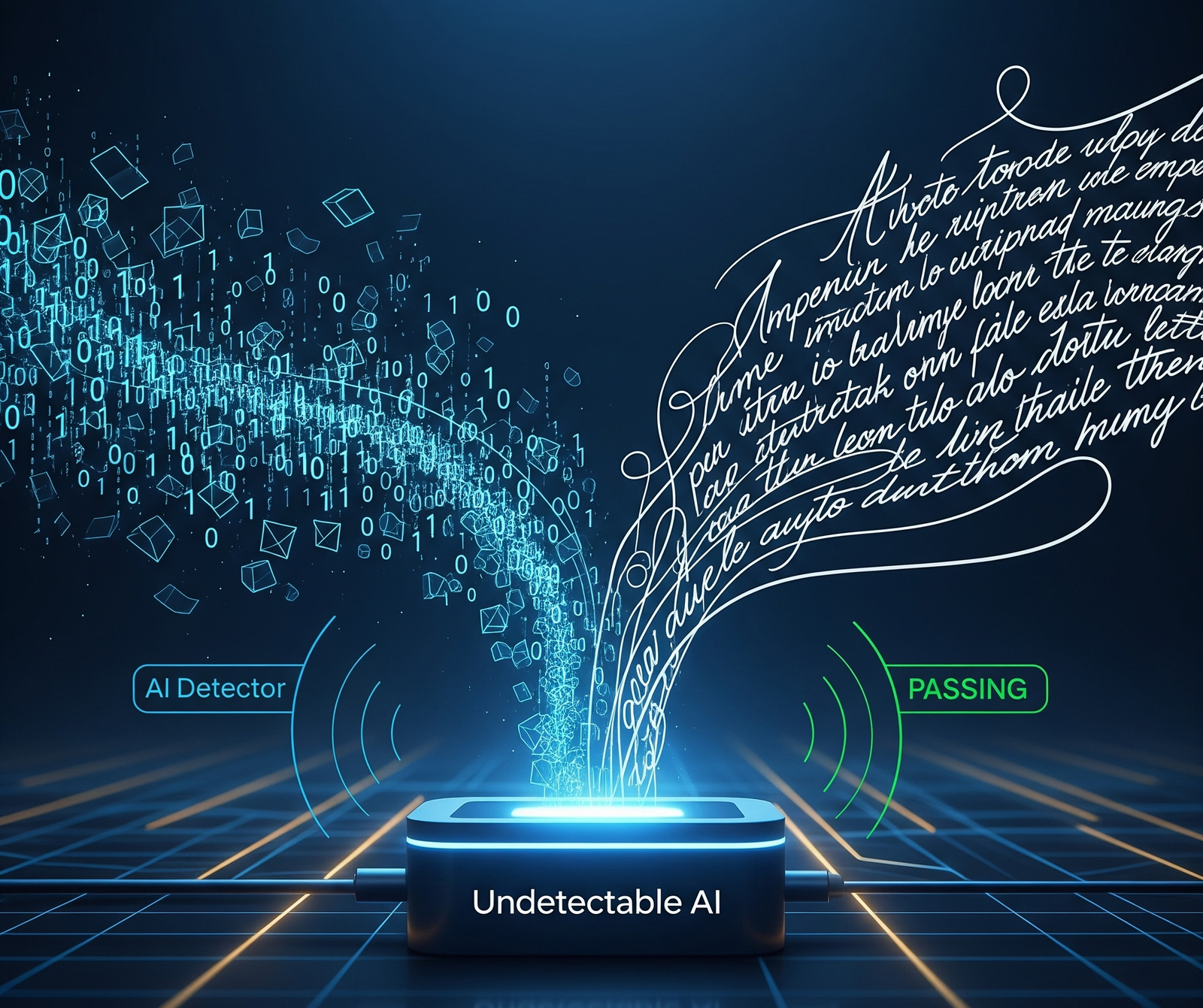
Undetectable AI refers to a set of techniques and tools designed to “humanize” AI-generated text, making it appear as if it was written by a human. The goal is to make the content indistinguishable from human-authored work, allowing it to bypass detection by AI content checkers. While some see this as a way to unfairly gain an advantage, others view it as a necessary tool to refine and polish AI’s output. This comprehensive guide will explore what undetectable AI is, how it works, why people use it, and the ethical considerations surrounding this new technology. We will explain everything in simple, easy-to-understand language.
1. The AI Content Revolution and the Rise of Detection
To understand undetectable AI, we first need to understand the two forces that created the need for it.
The AI Content Revolution
AI has made content creation faster and more scalable than ever before.
- Speed: AI can generate a long-form article in minutes, a task that would take a human writer hours.
- Efficiency: It allows businesses and individuals to create content at scale, whether for a blog, social media, or a website.
- Accessibility: Anyone can now create professional-looking content, regardless of their writing skills.
This speed and efficiency have led to an explosion of AI-generated content online.
The Need for AI Detection
As the volume of AI content grew, a new problem emerged: authenticity.
- Academic Integrity: Universities and schools needed a way to ensure that students were submitting original work and not simply copying from an AI.
- Search Engine Optimization (SEO): Google’s algorithms favor content that is helpful, original, and written by experts. While Google has stated it doesn’t penalize AI content just for being AI, it’s widely believed that low-quality, generic AI content may not rank well.
- Trust and Credibility: Readers often trust content more when they know it was written by a human.
In response to these needs, a new industry of AI content detectors was born. These tools, like GPTZero, Turnitin, and Copyleaks, analyze text for patterns commonly found in AI-generated writing.
2. What is Undetectable AI?
Undetectable AI is the technology that attempts to defeat these AI detectors. Its primary function is to transform a piece of text written by an AI into something that reads like it was written by a human.
The Core Technology: “Humanizing” AI Content
Undetectable AI tools don’t just use simple paraphrasing. They employ advanced algorithms to analyze and change the text at a deeper level.
- Pattern Disruption: AI models often use predictable sentence structures, a limited range of vocabulary, and repetitive phrases. Undetectable AI tools identify these patterns and actively rewrite the text to break them.
- Readability and Flow: These tools add variations in sentence length and complexity, use more diverse vocabulary, and adjust the tone to make the text feel more natural and engaging.
- Emulating Human Style: They try to mimic the quirks of human writing, such as using idioms, colloquialisms, and rhetorical questions, which AI often avoids.
The goal is not to change the meaning of the content but to change its style and structure so that it’s no longer flagged by a detector.
Key Features of a Humanizer Tool
A typical undetectable AI tool, often called an “AI Humanizer,” has a simple workflow.
- Input: You copy and paste the AI-generated text into the tool.
- Analysis: The tool may first run the text through its own AI detector to show you how “likely” it is to be flagged as AI.
- Humanization: You press a button, and the tool rewrites the text.
- Output: You get a new version of the text that is designed to be undetectable by AI checkers.
Some tools also offer a built-in AI detector so you can test the “humanized” output yourself.
3. Why Use Undetectable AI?
People use undetectable AI tools for a variety of reasons, from a desire for efficiency to a need for a professional tone.
For SEO and Content Marketing
- Scaling Content Production: Marketers can use AI to quickly generate a large volume of articles. Undetectable AI tools then help them polish this content to make it appear more authentic and user-friendly.
- Avoiding Penalties: While Google’s stance on AI content is nuanced, many content creators use humanizers to ensure their content is perceived as high-quality and original, which is crucial for ranking well on search engines.
- Improving Engagement: Humanized content is generally more readable and engaging for a human audience, which can lead to better user experience metrics that Google considers for ranking.
For Academic and Professional Writing
- Overcoming AI Detectors: Students may use these tools to ensure their work isn’t unfairly flagged by a school’s AI detector, especially since many of these detectors have a high rate of false positives (flagging human-written work as AI-generated).
- Polishing Drafts: Professionals and writers can use AI to generate a first draft and then use a humanizer to refine the tone, vocabulary, and flow, making the final piece more polished.
- Non-Native English Speakers: Some non-native English speakers may use these tools to improve the natural flow and grammar of their writing, ensuring their ideas are expressed clearly and professionally.
4. The Ethical Debate and Limitations
The use of undetectable AI is a controversial topic, with many ethical questions and technical limitations.
The Ethical Dilemma
- Academic Integrity: The most significant ethical concern is the potential for misuse in academic settings. It can be used to bypass integrity rules and submit work that is not original.
- Deception: The very nature of the technology is to deceive a system. This raises questions about honesty and transparency in content creation.
- Misinformation: Undetectable AI could potentially be used to generate and spread misinformation at a large scale, making it harder to identify and combat.
Many platforms and content creators are grappling with how to ethically use these tools and whether they should be used at all.
The Limitations of the Technology
- Not 100% Reliable: Undetectable AI tools are in a constant battle with AI detectors. A humanizer that works today might not work tomorrow, as detectors are also constantly being updated.
- Potential for Awkward Output: Sometimes, the “humanized” text can sound unnatural, clumsy, or even nonsensical, as the tool tries to break patterns in a way that doesn’t make sense.
- No Substitute for Human Expertise: A humanizer cannot add true expertise, personal experience, or deep insight to a piece of content. It can only work with the text it is given. It is a refinement tool, not a creator of original thought.
The most effective approach is a hybrid model, where AI is used for a quick first draft, and a human writer then heavily edits, refines, and adds their own unique voice and expertise to the content.
5. Frequently Asked Questions (FAQs)
Is it illegal to use Undetectable AI?
In most places, using such a tool is not illegal. However, it may violate the terms of service of a website, the academic integrity policy of a school, or the ethical guidelines of a company.
Can Undetectable AI pass every AI detector?
No single tool can guarantee it will bypass every AI detector. The technology is in an “arms race” where humanizers and detectors are constantly evolving to outsmart each other.
Does Undetectable AI also check for plagiarism?
Most undetectable AI tools claim to provide plagiarism-free content, but it is always recommended to use a separate, reliable plagiarism checker to be certain.
Is it a good idea to use Undetectable AI for a blog?
For a blog, the most important thing is creating content that is helpful, valuable, and authentic to your audience. Undetectable AI can be a part of the workflow, but it should not be a substitute for genuine expertise and human editing.
What is a “false positive” in AI detection?
A false positive is when an AI detector incorrectly flags a piece of human-written content as AI-generated. This is a common and serious problem, which is one reason why many people use humanizer tools.
Conclusion
In conclusion, undetectable AI is a fascinating and controversial new technology that has emerged as a direct response to the rise of AI content detectors. By using advanced algorithms to “humanize” AI-generated text, these tools offer a way to make content more readable, authentic, and less likely to be flagged.
While they provide a powerful shortcut for content creation and a potential solution to the problem of false positives, their use comes with significant ethical questions. The future of content creation will likely be a hybrid one, where AI assists with the initial draft, and human creativity, expertise, and critical editing remain essential for producing truly valuable, authentic, and undetectable content. It’s a tool that requires careful and responsible use, and its true value lies not in fooling a system, but in making AI a more effective partner for human writers.