
Introduction
The world of artificial intelligence is no longer just for expert scientists and large tech companies. AI is becoming an essential part of almost every industry, from improving customer service to automating complex tasks and even generating creative content. However, building AI solutions from scratch can be incredibly challenging, requiring deep knowledge of programming, machine learning algorithms, and vast amounts of data. This complexity often acts as a barrier for many individuals and businesses who want to leverage the power of AI. This is where AI Kits come into play.
AI Kits are essentially pre-packaged sets of tools, software, and sometimes hardware that simplify the process of developing, deploying, and integrating artificial intelligence into various applications and systems. They democratize AI, making it more accessible to developers, businesses, and even hobbyists without needing extensive AI expertise. By providing ready-to-use components and frameworks, AI Kits accelerate development, reduce costs, and allow innovators to focus on solving specific problems rather than building foundational AI infrastructure. This comprehensive guide will explore what AI Kits are, their different types, how they work, and why they are transforming the way we build with artificial intelligence.
1. What are AI Kits? Simplifying AI Development
At its core, an AI Kit is a collection of resources designed to make the creation and implementation of artificial intelligence easier and faster. Think of it like a LEGO set for AI – instead of making every brick yourself, you get pre-made pieces that you can assemble to build something incredible.
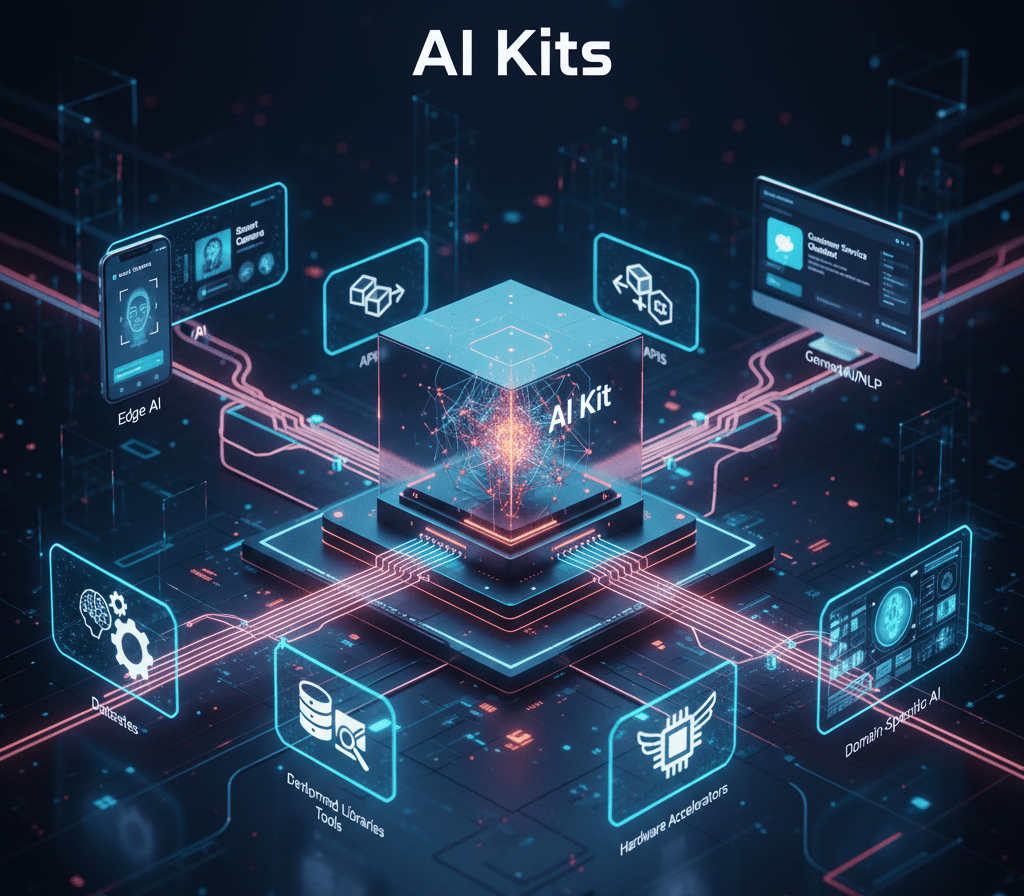
Components of an AI Kit
An AI Kit can include a variety of elements, depending on its purpose:
- Pre-trained Models: These are AI models (like language models, image recognition models, or predictive models) that have already been trained on vast datasets. This means they are ready to use for specific tasks without you needing to do the heavy lifting of training.
- Software Libraries and Frameworks: Collections of code (like TensorFlow, PyTorch, scikit-learn) that provide the building blocks and structure for developing AI applications.
- APIs (Application Programming Interfaces): These allow different software systems to communicate. Many AI Kits offer APIs to easily integrate AI services (like sentiment analysis or translation) into your existing applications.
- Development Tools: Integrated Development Environments (IDEs), debugging tools, and interfaces that help developers write, test, and deploy AI code.
- Datasets (sometimes): Curated collections of data used for training or testing AI models.
- Hardware (for some kits): Specialized hardware like AI chips (e.g., NVIDIA Jetson) that are optimized for running AI models, especially for edge computing.
The Core Purpose: Abstraction and Acceleration
AI Kits serve two main purposes:
- Abstraction: They hide the underlying complexity of AI algorithms and infrastructure, allowing users to interact with AI at a higher, more intuitive level.
- Acceleration: They drastically speed up the development cycle by providing ready-made solutions, reducing the time and resources needed to bring an AI-powered product to market.
2. Types of AI Kits and Their Applications
AI Kits come in various forms, each tailored for different needs and levels of expertise.
Cloud-Based AI Services (AI as a Service – AIaaS)
These are AI kits offered by major cloud providers, making powerful AI accessible via APIs.
- Examples: Google Cloud AI Platform, Amazon Web Services (AWS) AI/ML, Microsoft Azure AI.
- Features: Offer pre-trained models for tasks like natural language processing (NLP), computer vision, speech-to-text, and recommendation engines. They handle all the infrastructure.
- Use Cases: Integrating AI into web applications, mobile apps, business analytics, and automation workflows.
Edge AI Kits
These kits combine specialized hardware with software to run AI models directly on devices, not in the cloud.
- Examples: NVIDIA Jetson Developer Kits, Google Coral Dev Board.
- Features: Low power consumption, real-time processing, enhanced privacy (data doesn’t leave the device).
- Use Cases: Smart cameras for security, industrial automation, robotics, drones, and smart home devices.
Domain-Specific AI Kits
These kits are designed for particular industries or types of problems.
- Examples: AI kits for healthcare (e.g., for medical image analysis), finance (e.g., for fraud detection), or customer service (e.g., for building chatbots).
- Features: Pre-trained models and datasets relevant to that specific domain.
- Use Cases: Streamlining processes and enhancing decision-making in specialized fields.
Open-Source AI Frameworks & Libraries
While not “kits” in the strictest sense, these are foundational AI toolkits that developers use to build their own AI solutions.
- Examples: TensorFlow, PyTorch, scikit-learn, Hugging Face Transformers.
- Features: Provide flexibility and control for custom AI development.
- Use Cases: Research, building custom LLMs, developing complex machine learning models from scratch.
3. How AI Kits Work and Benefit Users
Understanding the workflow of AI Kits helps in appreciating their value.
The Simplified Workflow
- Select a Kit: Choose an AI Kit that matches your project’s needs (e.g., a cloud AI service for text analysis, an edge AI kit for a smart camera).
- Integrate: Use the provided APIs or software development kits (SDKs) to connect the AI capabilities with your application or device.
- Configure/Fine-tune (Optional): Some kits allow you to fine-tune pre-trained models with your own data to improve performance for specific tasks.
- Deploy: Launch your AI-powered application or device.
Key Benefits for Different Users
- For Developers: Speeds up development, reduces coding effort, and allows focus on unique application features rather than core AI algorithms.
- For Businesses: Reduces the cost and time-to-market for AI-powered products, enabling quicker innovation and competitive advantage.
- For Researchers: Provides access to powerful tools and models for experimentation and building upon existing AI advancements.
- For Non-AI Experts: Makes AI accessible, allowing individuals with limited AI knowledge to build intelligent features into their projects.
4. Real-World Applications of AI Kits
AI Kits are driving innovation across a multitude of industries.
Customer Service
- Building intelligent chatbots and virtual assistants using cloud-based NLP (Natural Language Processing) kits to handle customer inquiries, route calls, and provide instant support.
Content Creation
- Integrating generative AI kits (e.g., from OpenAI or Google) via APIs to automatically generate text for marketing copy, articles, or social media posts.
Smart Devices and IoT (Internet of Things)
- Using edge AI kits to embed intelligence directly into devices like smart cameras for facial recognition, smart home appliances for predictive maintenance, or industrial sensors for anomaly detection.
Healthcare
- Applying domain-specific AI kits for tasks like analyzing medical images (X-rays, MRIs) for early disease detection or personalizing patient treatment plans.
Automated Marketing
- Utilizing AI kits for sentiment analysis of customer reviews, predictive analytics for marketing campaigns, and personalizing product recommendations.
5. Frequently Asked Questions (FAQs)
Do I need to be an AI expert to use an AI Kit?
No, that’s one of the main benefits! Many AI Kits are designed for developers and businesses without deep AI expertise, allowing them to integrate powerful AI features using straightforward APIs or user-friendly interfaces.
Are AI Kits expensive?
The cost varies greatly. Many cloud-based AI services offer free tiers or pay-as-you-go models. Hardware-based edge AI kits have an upfront cost for the hardware. The overall cost is often significantly less than building AI from scratch.
What is the difference between an AI Kit and a pre-trained model?
A pre-trained model is a component within an AI Kit. An AI Kit is a broader package that might include pre-trained models, along with APIs, software libraries, documentation, and sometimes even hardware, to help you use and deploy that model effectively.
Are AI Kits secure?
Reputable AI Kit providers (especially cloud-based ones) implement strong security measures, data encryption, and compliance with privacy regulations. However, users are also responsible for securing their applications and data.
Can I customize the AI models within a kit?
Yes, many advanced AI Kits allow for “fine-tuning,” where you can further train a pre-trained model with your specific data to improve its performance for your unique use case.
Conclusion
In conclusion, AI Kits are revolutionizing the way we develop and deploy artificial intelligence. By providing pre-packaged, ready-to-use components and frameworks, they significantly lower the barrier to entry for AI development, making this powerful technology accessible to a much wider audience. Whether you’re a seasoned developer looking to accelerate your projects, a business aiming to integrate AI without massive investment, or an innovator building the next generation of smart devices, AI Kits offer a streamlined and efficient path to success.
These kits are not just tools; they are catalysts for innovation, enabling faster development, reducing costs, and democratizing the power of AI across every sector. As AI continues to evolve, AI Kits will undoubtedly play an increasingly critical role in making artificial intelligence a practical and indispensable part of our everyday lives and technological advancements.