
Hunyuan Video-Foley: In the fast-paced world of AI-generated content, we have seen incredible advancements in visual quality. From hyper-realistic AI-generated images to stunning, coherent videos, the visuals are getting better every day. However, a major piece of the puzzle has been missing: sound. AI-generated videos often feel incomplete, eerie, and unnatural because they are silent or have a generic, poorly synchronized soundtrack.
This is a problem that the film industry has long solved with Foley art—the painstaking process of creating and synchronizing everyday sounds to match the on-screen action. Now, this classic art form has met the power of AI with Hunyuan Video-Foley, a revolutionary AI model from Tencent.
Hunyuan Video-Foley is an end-to-end framework that can generate professional-grade, high-fidelity audio that is perfectly synchronized with the visuals in a video. It is designed to turn silent videos into immersive, lifelike experiences by adding sounds like footsteps, rustling leaves, or the clink of a glass, all in the right place at the right time.
This in-depth guide will explore the groundbreaking technology behind Hunyuan Video-Foley. We will discuss its key innovations, understand how it solves the biggest challenges in AI audio generation, compare it with other models, and see how it can be used to transform content creation for filmmakers, animators, and creators everywhere.
What is Hunyuan Video-Foley? The End-to-End Audio Synthesis Framework
Hunyuan Video-Foley is a state-of-the-art Text-Video-to-Audio (TV2A) framework developed by Tencent Hunyuan. Its primary purpose is to generate high-fidelity, context-aware, and perfectly synchronized audio for silent videos.
The name “Foley” is a direct nod to the traditional art of creating sound effects in post-production. Hunyuan Video-Foley automates this time-consuming and expensive process by using a sophisticated AI model that understands both the visual cues in a video and the textual context provided by a user.
Why Hunyuan Video-Foley is a Game-Changer
For a long time, video-to-audio (V2A) models have struggled with three main issues:
- Data Scarcity: There were no large-scale, high-quality datasets of video, audio, and text descriptions that were perfectly aligned.
- Modality Imbalance: The AI often paid more attention to the text prompt than to the visual details of the video, leading to mismatched sounds.
- Limited Audio Quality: The generated audio was often low-fidelity, noisy, and unconvincing.
Hunyuan Video-Foley solves these problems with a novel approach, making it the first open-source model to consistently set new state-of-the-art benchmarks in audio quality, temporal synchronization, and multimodal semantic alignment.
The Core Innovations Behind Hunyuan Video-Foley
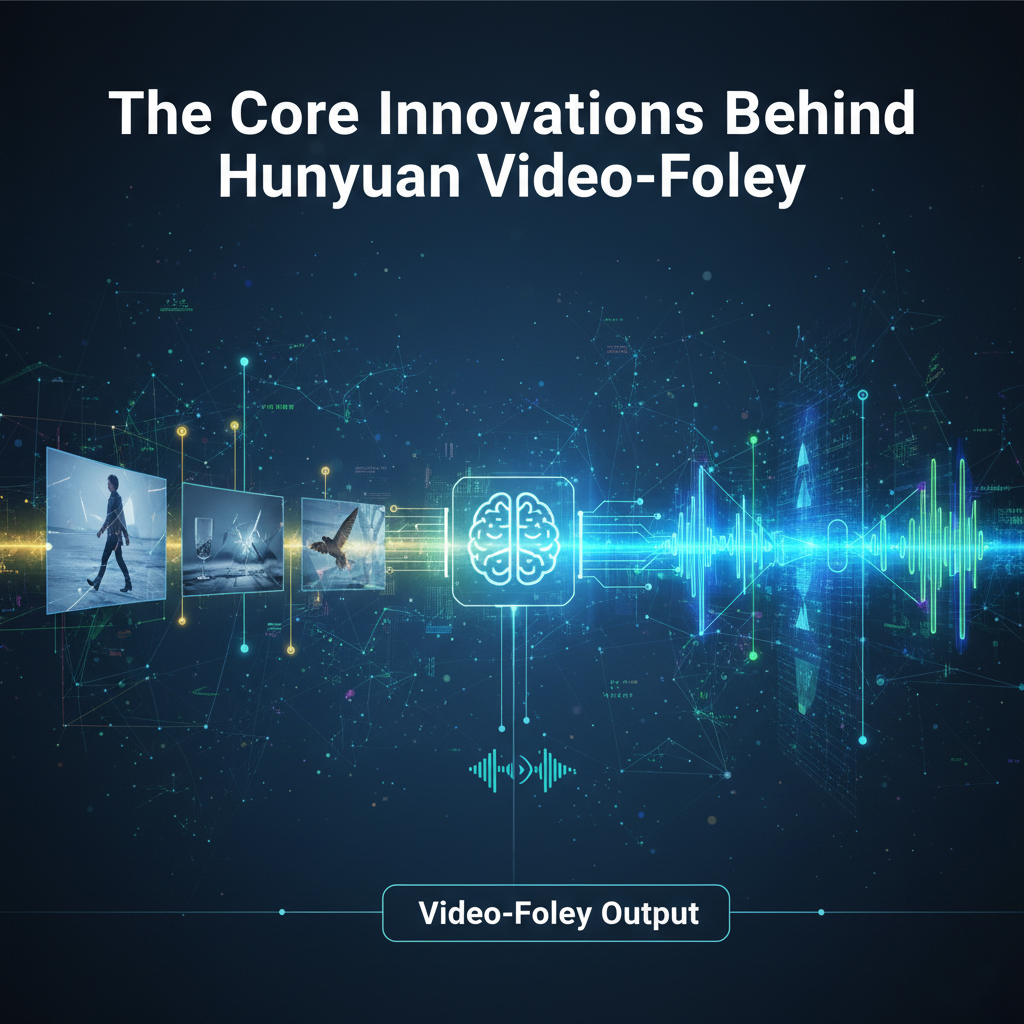
The exceptional performance of Hunyuan Video-Foley is the result of three core innovations in its architecture and training pipeline.
1. Scalable Data Pipeline
Tencent’s team knew that a great model needs a great dataset. They created a massive, curated library of 100,000 hours of text-video-audio pairs. This wasn’t a manual process; they built a multi-stage automated pipeline that:
- Filtered out poor quality videos: They removed clips with long silences or fuzzy, low-quality audio.
- Segmented and Annotated: Long videos were segmented into smaller, 8-second clips. An automated annotation model then tagged each segment, ensuring that the sound, video, and text descriptions were perfectly aligned.
- Ensured High Fidelity: The pipeline used bandwidth and signal-to-noise ratio (SNR) analysis to ensure the audio was professional-grade with a high sampling rate of 48 kHz.
This meticulous data curation process provided the AI with a “clean” and massive learning environment, which is a major reason for its success.
2. Dual-Stream Transformer Architecture
Hunyuan Video-Foley uses a clever, two-stage attention system to overcome the problem of modality imbalance.
- Visual-Audio Attention: In the first stage, the model pays very close attention to the visual and audio streams to get the timing just right. It learns to match the “thump” of a footstep to the exact frame where a shoe hits the pavement.
- Semantic-Textual Attention: After the timing is locked in, the model then incorporates the text prompt to understand the overall context and mood. For example, if the video shows a person walking in the rain, the text prompt “sound of rain” helps the model generate realistic rain sounds without overpowering the footstep sound.
This dual-stream approach ensures that the audio is both perfectly synchronized with the visuals and semantically aligned with the user’s intent.
3. Representation Alignment (REPA) Loss
To ensure the generated audio is of the highest quality, Hunyuan Video-Foley uses a training strategy called Representation Alignment (REPA).
- This is like having an expert audio engineer constantly supervising the AI’s training.
- The system compares the AI’s generated audio to features from a pre-trained, professional-grade audio model.
- This “expert guidance” helps the AI produce cleaner, richer, and more stable sound, free from noise and artifacts.
This technique is what gives Hunyuan Video-Foley the ability to produce “broadcast-ready” audio that can be used directly in professional projects.
Real-World Applications and Use Cases

The ability to generate synchronized, high-quality audio has a transformative impact on various industries.
- Filmmaking and Post-Production: Indie filmmakers and animators can save immense time and money by using Hunyuan Video-Foley to automatically add sound effects to their films. This tool can create everything from the sound of a rustling jacket to the roar of a car, all perfectly timed to the action.
- Short-form Content Creation: For platforms like TikTok and Instagram Reels, creators can turn their silent videos into engaging clips with professional-grade soundscapes in minutes, drastically improving viewer immersion.
- Game Development: Game developers can use the tool to quickly generate sound effects for character animations, environmental elements (e.g., wind, rain), or in-game events, speeding up the development pipeline.
- Advertising and Marketing: Ad agencies can create dynamic and immersive video ads with custom-generated audio, enhancing the emotional impact of their campaigns.
Hunyuan Video-Foley is a true democratization of sound design, making a previously complex and expensive art form accessible to everyone.
Hunyuan Video-Foley vs. Other AI Audio Tools
While other AI audio tools exist, Hunyuan Video-Foley stands out because of its focus on synchronization and high fidelity.
- Think-Sound: An open-source AI framework that also adds sound to silent videos. While a good tool, Hunyuan Video-Foley’s performance consistently ranks higher on key benchmarks, particularly in temporal and semantic alignment.
- Generic AI Audio Generators: Tools like Meta’s AudioGen or Google’s AudioLM are excellent for generating music or general sound, but they are not built for the precise, frame-by-frame synchronization required for Foley art.
Hunyuan Video-Foley’s unique two-stage architecture and its dedicated focus on TV2A make it a specialist in its field, giving it a significant advantage over more general-purpose AI audio tools. It solves the specific and difficult problem of making video and audio work in perfect harmony.
The Future of AI in Video Production
The release of Hunyuan Video-Foley marks a new chapter in AI-powered content creation. The future will likely see:
- Even Greater Realism: Future models will be able to generate nuanced sounds based on material types (e.g., the difference between footsteps on gravel vs. on wood), creating an even more immersive experience.
- Spatial Audio: AI will be able to generate spatial audio (3D sound) that can be used in virtual reality, augmented reality, and gaming.
- Real-Time Processing: Models will become so fast that they can generate audio for a live video stream, opening up possibilities for live broadcasting and interactive content.
Hunyuan Video-Foley is a powerful first step towards this future, proving that AI can be an invaluable partner in the creative process, bridging the gap between silent visuals and professional-grade audio.
Conclusion
Hunyuan Video-Foley is a monumental achievement by Tencent. It is a powerful, open-source framework that has effectively solved the long-standing problem of creating high-quality, synchronized audio for AI-generated videos. Its innovative data pipeline, dual-stream architecture, and representation alignment techniques have set a new standard for the industry.
By automating the art of Foley, Hunyuan Video-Foley empowers creators of all levels to produce more professional, immersive, and emotionally resonant videos. It’s a tool that not only enhances the viewing experience but also saves countless hours of post-production work.
In a world where content is king, sound is the soul. Hunyuan Video-Foley ensures that AI-generated content finally has that soul, cementing its place as a game-changer in the video production landscape.