
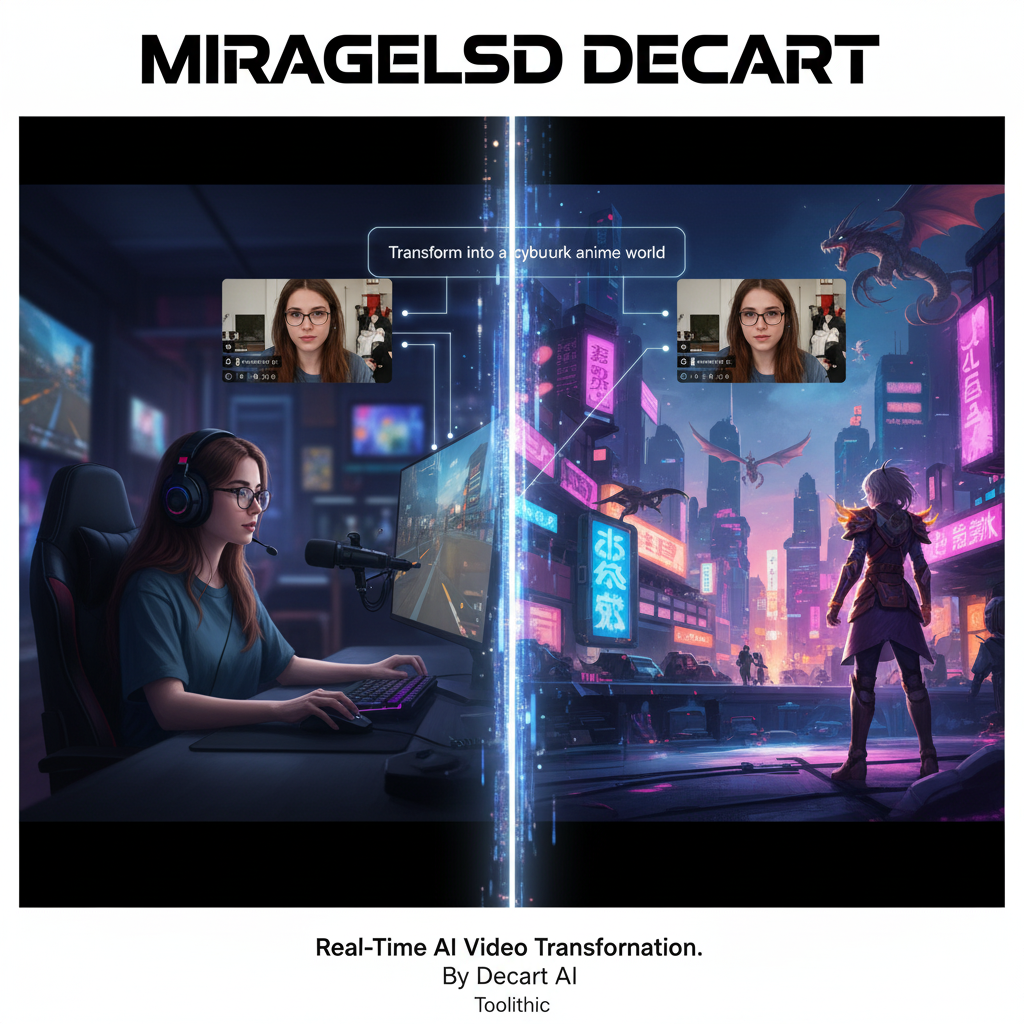
For years, the world of video has been divided into two separate realms: live content and edited content. Live streams were raw and unpolished, while highly stylized and creative visuals required hours of post-production. The dream of a tool that could instantly and magically transform live footage turning a video call into an anime scene or a gameplay stream into a fantasy world—seemed like science fiction.
But that dream is now a reality. MirageLSD, a groundbreaking Live-Stream Diffusion (LSD) AI model from the innovative startup Decart, is completely revolutionizing the field of AI video. This is not just another text-to-video tool; it is a specialized AI that can transform any video stream from a webcam to a live game in real-time, with incredibly low latency. It is a portal to a new digital reality where your imagination is the only limit.
This in-depth guide will take you on a deep dive into MirageLSD. We will explore its innovative architecture, understand how it achieves its superior speed and stability, compare its performance with other leading models, and discuss the profound impact it is having on the future of live streaming and interactive entertainment.
What is MirageLSD? Live-Stream Diffusion, Explained
MirageLSD is a sophisticated video-to-video AI model designed to transform any video stream in real time. Developed by the Israeli startup Decart, it is a foundational model that focuses on providing creators with a high degree of artistic control over their live content. The “LSD” in the name stands for Live-Stream Diffusion, which is the core technology that sets it apart from its rivals.
At its core, MirageLSD is built on a specialized Diffusion Transformer architecture. This allows the model to understand a user’s text prompt and the live video input, and then instantly generate a new, stylized video feed. The primary purpose of MirageLSD is to be a versatile tool for live content creators, offering a single platform for a wide range of real-time creative tasks.
The Problem of Live AI: Why This is a Major Breakthrough
The biggest challenge for AI in live video has always been latency and temporal coherence.
- Latency: Most AI models are slow. Generating a single video frame can take several seconds, which is a non-starter for live streaming. MirageLSD, on the other hand, can generate a frame in under 40 milliseconds, allowing it to achieve a smooth 24 frames per second.
- Temporal Coherence: This is a major issue for autoregressive models, which generate each new frame based on the previous one. Over time, the AI can accumulate small errors that eventually lead to visual “drift” or a complete collapse of the image. MirageLSD was specifically designed to solve this problem, allowing for infinitely long, stable live streams.
MirageLSD addresses these issues with two groundbreaking training techniques, which we will discuss in the next section.
The Technology Under the Hood: A Deep Dive into MirageLSD’s Architecture
The incredible performance of MirageLSD is the result of a sophisticated architectural design and a revolutionary training approach. It’s a testament to how specialized AI can solve specific, real-world problems.
[Image placeholder for a diagram showing the “Live-Stream Diffusion” process, with a live video feed, a text prompt, and the AI generating a new, transformed video feed in real-time.]
1. Diffusion Forcing: The Key to Infinite Generation
MirageLSD is an autoregressive model, meaning each new frame is generated based on the previous frame. This creates a risk of error accumulation. To solve this, Decart’s team developed a technique called Diffusion Forcing.
- How it works: Instead of training the model on perfect, clean frames, Diffusion Forcing adds noise to each frame individually. This teaches the model to denoise each frame from scratch, without relying too heavily on the previous frame. This prevents the model from passing on errors and allows for infinitely long video streams without the quality degrading.
2. History Augmentation: Learning from its Own Mistakes
The second innovation is History Augmentation. This technique is designed to further improve the model’s stability and coherence.
- How it works: During training, the model is fed a stream of corrupted or “faulty” frames from its own past outputs. This teaches the AI to recognize and correct these recurring mistakes, so it learns to spot and fix visual artifacts during real-time generation.
These two techniques, combined with a highly optimized architecture, are what allow MirageLSD to achieve a level of stability and performance that its rivals have struggled with.
MirageLSD vs. The Competition: A Head-to-Head Comparison
The AI generative landscape is a battleground of giants. Here’s how MirageLSD measures up against its key competitors like Google’s Veo and the general capabilities of other models like Kling AI and Wan 2.2. We will focus on the unique strengths that set them apart.
| Feature | MirageLSD | Google Veo 3 | Wan 2.2 |
| Developer | Decart | Alibaba | |
| Core Function | Real-Time Video Transformation | Static, cinematic video generation | Image and Video Generation |
| Key Advantage | Extremely low latency for live streaming and interaction. | Highest-quality, photorealistic video clips. | Superior artistic and cinematic control. |
| Temporal Coherence | Excellent (with unique training) | Exceptional | Very good |
| Use Case | Live streaming, video calls, gaming. | Filmmaking, advertising. | Concept art, ad campaigns. |
Export to Sheets
MirageLSD’s unique strength lies in its specialization. While Google’s Veo and Wan 2.2 are focused on creating beautiful, static video clips, MirageLSD is the go-to tool for creators who need to transform their video content live. This is a significant advantage for platforms like Twitch and YouTube. For more on other AI tools, you can read our guide on [The Ultimate Guide to Kling AI] to see how its focus on long-form video compares to MirageLSD’s focus on real-time transformation.
Real-World Applications for Creators and Businesses
The capabilities of MirageLSD open up a world of possibilities for professionals and creators. Here are some of the ways it can be used to revolutionize the creative process:
- Live Streaming and Content Creation: A streamer can transform their gameplay into a stylized, animated world in real-time. A creator can make their webcam feed look like a sci-fi character or a cartoon, all with a simple text prompt.
- Interactive Media: A game developer can use this AI to create dynamic content where a viewer can influence the video in real-time. The viewer could type a prompt, and the AI would instantly change the style of the stream.
- Video Conferencing: For virtual meetings and video calls, users can change their background into a beautiful, AI-generated scene without needing a green screen. They could even change their own appearance to be an avatar.
- Digital Art and Performance: Artists can use MirageLSD to create live, interactive digital art performances where their movements and gestures are instantly transformed into a dynamic visual show.
To learn more about a different kind of creative AI, you can check out our article on the [The Ultimate Guide to Wan 2.2].
Conclusion: MirageLSD is a New Frontier for Interactive Media
MirageLSD by Decart is a monumental achievement in the field of AI. It is a powerful, open-source AI model that is setting a new standard for AI-powered video transformation. Its innovative Diffusion Forcing and History Augmentation training make it a formidable tool for live content creators.
For streamers, developers, and aspiring designers, MirageLSD is a game-changer. It is a tool that not only enhances the speed of their work but also provides a level of accessibility and control that was previously impossible.
MirageLSD is a clear signal that the future of AI is not just about generating video clips, but in creating entire interactive worlds that we can engage with in real time. It is a true game-changer that will shape the future of media and entertainment. To learn more about this model, you can read the official announcement on the Decart AI blog.