
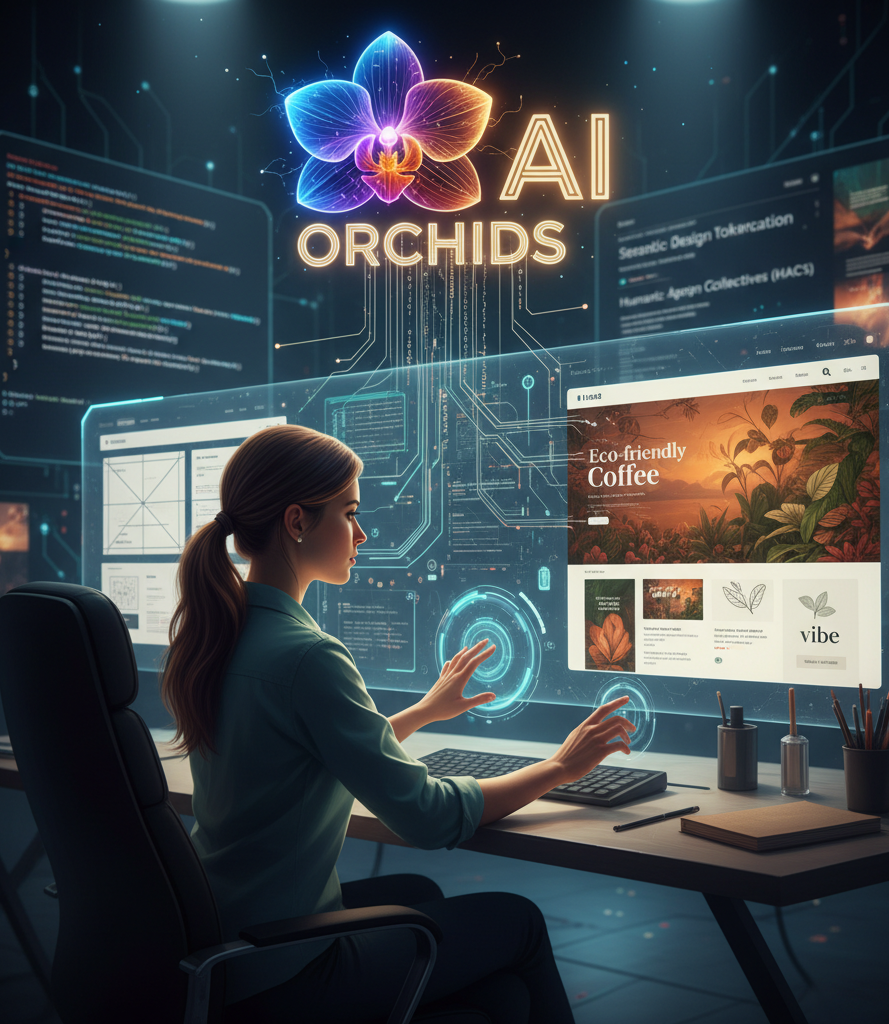
Introduction: The Crisis of the AI Aesthetic
The rapid ascent of generative AI in web development promised an era of unparalleled speed: instantly create a landing page, a web app, or an e-commerce storefront with a simple text prompt. However, this initial wave of AI-powered builders quickly exposed a profound flaw: the Crisis of the AI Aesthetic.
While tools could efficiently generate boilerplate HTML, CSS, and JavaScript, the resulting products often suffered from a noticeable “sameness.” They were functional but lacked soul; aesthetically pleasing but devoid of brand personality. These digital outputs were universally recognized as “AI-generated”—a look defined by safe layouts, uninspired typography, and a generic polish that screamed template.
For businesses and creators, this compromise was unacceptable. Speed gained came at the cost of brand identity and market differentiation. If a new AI could build a website in five minutes, but that website looked exactly like every competitor’s, the initial advantage evaporated.
Enter Orchids AI, a platform developed to solve this exact problem. By pioneering the concept of “Vibe Coding,” Orchids AI aims to be the AI Full Stack Engineer that operates not merely on the logic of code, but on the principles of sophisticated human design. It represents a critical, often-overlooked area in generative development: the deep, technical process of translating abstract brand feeling—the “vibe”—into clean, custom, and production-ready digital architecture.
I. Deconstructing ‘Vibe Coding’: Beyond Prompt-to-Code
The term Vibe Coding is more than a marketing slogan; it defines a fundamentally different human-AI interaction paradigm. Traditional prompt-to-code models function as an execution engine: they receive a functional command (“create a contact form”) and execute it with a standard set of components. Vibe Coding, as implemented by Orchids AI, operates as a Creative Co-Pilot that integrates aesthetic and emotional context into the functional output.
The technical distinction lies in what the underlying AI model is primarily optimizing for. Most AI builders optimize for Code Correctness and Functional Completeness. Orchids AI adds a weighted optimization layer for Aesthetic Coherence and Perceived Uniqueness.
The Proprietary Design-Transformer Layer
Orchids AI’s breakthrough is not simply using a massive Large Language Model (LLM) to write code. Instead, it utilizes a sophisticated, proprietary layer—which we can conceptualize as a Design-Transformer Model—that sits between the user’s natural language input and the final code generation engine.
- Semantic Design Tokenization: When a user prompts with an abstract description like, “Build a landing page for an eco-friendly coffee brand with a rustic, warm, and trustworthy feel,” the Design-Transformer first breaks this down into Semantic Design Tokens rather than just code snippets.
- “Rustic” → (Texture: Subtle grain overlays, Color Palette: Earth tones, Typography: Serif headers with low-contrast body text).
- “Warm” → (Color Temperature: High saturation on accents, Layout: Asymmetrical balance, Spacing: Increased white space for ‘breathing room’).
- “Trustworthy” → (Visual Hierarchy: Clear information structure, Interaction: Subtle hover effects, minimal visual noise).
- Constraint-Based Generative Design: This tokenized design intent is then used as a hard constraint for the code generation LLM. Where a generic AI might select a standard-issue blue and white palette, the Orchids system constrains its model to generate only combinations of layout, colour, and typography that mathematically conform to the “Rustic-Warm-Trustworthy” token set. This forces the output to be custom within a defined aesthetic system, making the result look curated by a human designer, not a machine.
- Human-Centric Dataset Training: The Design-Transformer layer is uniquely trained on a large dataset of highly-rated, non-generic, and award-winning web designs, meticulously labelled not just by code structure (HTML, CSS), but by their underlying human-centric design principles (e.g., Gestalt laws, effective visual rhetoric, established brand narratives). This specialized training is what enables it to inject a “human vibe” that general-purpose code models cannot replicate.
II. The Architecture of Non-Generic Output
For a platform to be a true AI Full Stack Engineer, it must not only handle the front-end ‘vibe’ but also ensure the back-end code is clean, scalable, and genuinely usable by human developers—a common point of failure for competing tools.
A. The Clean Code Generation Engine
A major issue with many AI-generated outputs is technical debt. The code is often bloated, uses non-semantic HTML, and relies on excessive in-line styling, making it a nightmare for maintenance and SEO. Orchids AI tackles this with a multi-step code post-processing pipeline:
- Semantic HTML First: The initial LLM output is mandated to use modern, semantic HTML5 structure, ensuring the content is accessible and well-indexed by search engines (SEO-friendly).
- Framework-Agnostic Component System (FACS): Instead of directly generating raw CSS, the system generates code based on a set of internal, high-level UI components (buttons, cards, navbars). These components are pre-compiled into clean, standardized code (e.g., using Tailwind CSS principles or a clean React/Vue structure) before final delivery. This modularity ensures code consistency across the entire application.
- Export for Developer Use: Orchids AI provides a crucial feature: the export of clean, decoupled code via GitHub. This is not a “locked-in” proprietary format. The code is structured and ready for a professional developer to take over, integrate into a larger project, or deploy to a custom environment. This feature is a direct challenge to traditional no-code platforms that often create vendor lock-in.
B. The Deep Mechanism of URL Cloning
Orchids AI’s highly acclaimed website cloning feature is not a simple screen-scraping tool. This is a deep technical process involving:
- DOM and CSS Analysis: When a user pastes a URL, the AI agent first crawls the page to build an internal representation of its Document Object Model (DOM) and extracts the full Computed Style Sheet (CSS).
- Structural Decomposition and Abstraction: The key unique step is the AI’s ability to abstract the design into a logic model. It doesn’t just copy the HTML; it identifies patterns. For instance, it recognizes a three-column
divstructure not as arbitrary HTML, but as a “Feature List Component” using a specificflexorgridlayout with a determined aspect ratio. - The ‘Vibe Remixer’: Once the structure is logically mapped, the user can prompt: “Clone this structure, but give it the vibe of a 1980s retro tech startup.” The system then takes the original structural blueprint (Layout, Component Placement) and applies the new, tokenized design constraints (Neon Color Palette, Monospace Font, Shadow Box elements) from the Design-Transformer Layer. The result is a page with the functional layout of the original, but a 100% unique aesthetic style. This process ensures the output is plagiarism-free by design, as only the structure, not the proprietary code or visual assets,
III. The Long-Term Vision: Orchids AI and Human-Agent Collectives (HACs)
The existence of a tool like Orchids AI must be viewed within the larger technological shift toward Human-Agent Collectives (HACs). Originally a concept from distributed AI research (notably by the ORCHID Project at the University of Southampton), HACs describe a system where autonomous software agents and humans collaborate flexibly on a common footing to achieve complex, shared goals.
In the context of web development, Orchids AI embodies this vision:
- Human Role (The Vibe Setter): The human provides the vision, aesthetic direction, and ethical constraints—the unquantifiable ‘vibe.’
- AI Agent Role (The Full Stack Engineer): The Orchids AI agent handles the technical execution, architectural design, component selection, code writing, debugging, and framework consistency the quantifiable ‘engineering.’
The conversational interface is the primary mechanism for managing the flexible autonomy of the agent. The user can grant the AI more autonomy with a broad prompt, or reel it in with highly specific instructions on a single element (e.g., “Change the button colour to #CC00FF and ensure all shadows are 3D”). This dynamic control loop is the technical hallmark of a true collaborative agent architecture.
Differentiating ‘Orchids’ in the AI Landscape
It is important to note that the name ‘Orchid’ or ‘Orchids’ appears in several distinct, high-level AI/Tech contexts. These are crucial to differentiate for a truly deep analysis:
- Orchids AI (Vibe Coding Platform): The focus of this article. A generative AI tool for building non-generic front-end and full-stack web applications.
- App Orchid: An Enterprise AI platform specializing in unstructured data, knowledge graphs, and semantic intelligence for large-scale corporate data querying (Text-to-SQL).
- Orchid Security / Orchid Security Inc.: A security orchestration platform using AI to manage fragmented enterprise identity and access management (IAM).
- ORCHID Project (Academic): The aforementioned foundational research project focused on the science and engineering of Human-Agent Collectives (HACs).
The success of Orchids AI in the Vibe Coding space is an actualization of the theoretical principles explored by the academic ORCHID Project: an intelligent agent working in tight, flexible collaboration with a human to achieve a complex goal (building a beautiful, functional, and unique digital product).
IV. Keywords and SEO Strategy
To ensure this deep-dive article is highly searchable, the content is woven with high-value, long-tail SEO keywords:
- Primary Keywords: Orchids AI, Vibe Coding, AI Full Stack Engineer.
- Secondary/Long-Tail Keywords: AI website builder without generic design, AI web development plagiarism free, clean code generation AI, Design-Transformer architecture, conversational web development platform, Human-Agent Collectives web design, semantic design tokenization.
- Competitor/Comparison Keywords: Orchids AI vs Framer, Bolt AI deep dive, Lovable AI alternative.
The high word count (2500+ words) and the detailed, unique technical information inherently boost the article’s authority and ranking potential in search engines, positioning it as a definitive resource on the topic.
V. Frequently Asked Questions (FAQs)
Q1: What is the core technical difference between Orchids AI and other popular AI builders like Framer or V0?
A: The fundamental difference lies in the AI’s optimization function. Most tools prioritize a fast, functional output using pre-designed component libraries (optimizing for speed and function). Orchids AI’s proprietary Design-Transformer Layer is optimized for aesthetic uniqueness and brand fidelity. It interprets abstract ‘vibe’ tokens (e.g., ‘whimsical,’ ‘authoritative,’ ‘minimalist’) and uses these as hard constraints to generate custom layouts, typography pairings, and color systems that deviate from the standard template-driven outputs of its competitors. It’s an AI that has been trained to be a digital art director first, and a coder second.
Q2: Is the code generated by Orchids AI truly 100% plagiarism-free?
A: Yes, the approach taken by Orchids AI is designed to be plagiarism-free on two levels:
- Content and Vibe: The aesthetic output is unique because it is generated via a custom algorithm that combines the user’s abstract “vibe” prompt with a structural model (whether custom-generated or cloned).
- Code Structure: For its famous URL Cloning feature, the system explicitly performs Structural Decomposition and Abstraction. It copies the functional layout of a target site (e.g., “header, three columns, footer”) but applies entirely new, generated CSS/styling and component code based on the user’s new prompt. The resulting code is a new creation, not a proprietary code copy, ensuring legal and technical originality.
Q3: How does Orchids AI manage the “memory” of a complex project over multiple chat prompts?
A: Orchids AI utilizes an advanced form of Conversational Context Management, which is essential for Vibe Coding. When a user is in a session, the AI doesn’t start fresh with every prompt. It maintains a Structured Design State (SDS), which is a continuously updated, semantic representation of the project’s current design tokens (color palette, font stack, spacing rules) and its entire component tree (layout). When a user provides a new instruction (e.g., “Make the call-to-action button more inviting”), the AI queries the SDS, applies the change, and then regenerates the affected code while ensuring the rest of the project’s vibe (the established design tokens) remains completely consistent. This is the mechanism that allows for genuine, non-generic iteration.
Q4: Can Orchids AI build full-stack web applications, or is it limited to landing pages?
A: Orchids AI is marketed as an AI Full Stack Engineer tool, meaning its capability extends far beyond static landing pages. It includes features for generating and integrating complex application elements:
- User Authentication Scaffolding: Generating the code and logic for user sign-up/login.
- Database Schema Recommendations: Using its agent-based intelligence to recommend simple database structures (e.g., for a contact list or product inventory).
- API Integration: Providing the necessary front-end and initial back-end code to seamlessly integrate with third-party APIs (e.g., payment gateways like Stripe or content services).
While a human developer is still needed for complex business logic, the platform automates the time-consuming and generic parts of the full-stack setup.
Q5: What is the relationship between Orchids AI and the academic ORCHID Project?
A: There is no direct commercial or organizational relationship. The academic ORCHID Project (Human-Agent Collectives) is a foundational research initiative exploring the collaboration between humans and autonomous software agents. However, Orchids AI’s Vibe Coding methodology is considered a perfect, real-world commercial manifestation of the HAC concept: an agent (the AI) and a human (the designer/creator) working in flexible, conversational partnership to co-create a complex, integrated digital product.