
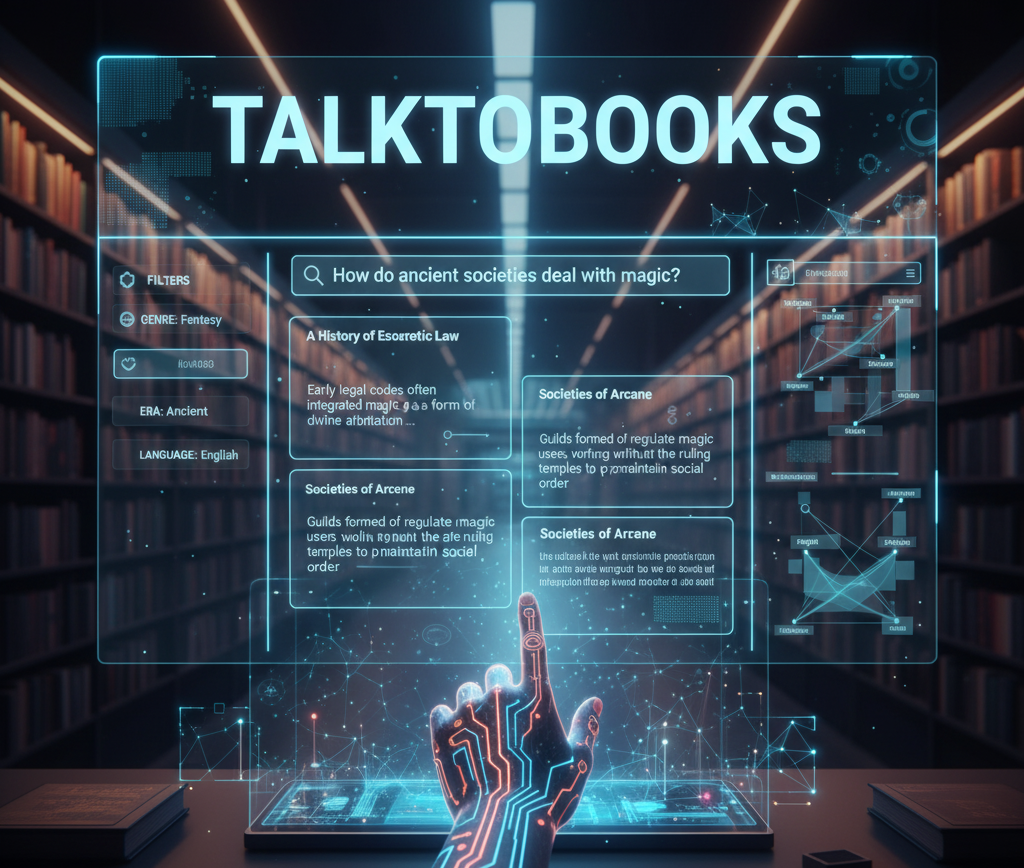
In an age overwhelmed by information, the challenge is no longer merely finding data, but discerning meaning and extracting contextual insights. Traditional search engines, while powerful, often rely on keyword matching, leading to results that are syntactically relevant but semantically shallow. This fundamental limitation spurred the development of TalkToBooks, an experimental tool from Google AI that redefines how humans interact with vast repositories of text.
TalkToBooks is not a search engine in the conventional sense; it is a semantic search interface powered by an advanced neural network that allows users to “converse” with millions of books. Instead of matching keywords, it matches ideas. You pose a question or a statement, and the AI scours its massive library, not for the exact words, but for passages that conceptually respond to your input, regardless of the specific vocabulary used.
This comprehensive, original analysis will delve into the pioneering AI architecture underpinning TalkToBooks, explore its philosophical implications for information retrieval and literacy, detail its specialized applications in research and learning, and discuss its transformative potential for democratizing access to complex textual knowledge. This is an exploration of how an algorithm designed to “understand” is fundamentally changing the way we interact with the written word.
I. The AI Architecture: Beyond Keywords to Semantic Understanding
The core innovation of TalkToBooks lies in its ability to transcend superficial keyword matching, moving towards a deeper, semantic understanding of both the user’s query and the book content. This is achieved through sophisticated neural network models.
A. Universal Sentence Encoder (USE): The Engine of Meaning
At the heart of TalkToBooks is Google’s Universal Sentence Encoder (USE). This is not a simple natural language processing (NLP) algorithm; it’s a pre-trained deep learning model designed to encode text into high-dimensional vectors (embeddings).
- Vector Representation: Every sentence, paragraph, and user query is converted into a numerical vector. Crucially, sentences with similar meanings, even if they use entirely different words, will have vector embeddings that are closer to each other in the vector space. For example, “How do I grow vegetables?” and “What’s the best way to cultivate garden produce?” would be mapped to very close points in this semantic space.
- Pre-training on Diverse Data: The USE model is pre-trained on a vast array of internet text (e.g., Wikipedia, web news, online forums) to learn the general characteristics of language, word usage, and semantic relationships. This foundational understanding allows it to generalize to new, unseen text, including books.
- Efficiency for Scale: Encoding an entire library of millions of books into these vectors is a massive computational task. However, once encoded, comparing the vector of a user’s query against the vectors of book passages is incredibly fast, enabling near real-time semantic search across an enormous corpus.
B. The Matching Algorithm: From Query to Relevant Passage
When a user types a query into TalkToBooks, the following sophisticated sequence of events unfolds:
- Query Encoding: The user’s question or statement is immediately processed by the USE model and converted into its unique semantic vector.
- Vector Similarity Search: This query vector is then compared against the pre-computed vectors of every passage within the TalkToBooks library. The system uses efficient nearest-neighbor search algorithms (e.g., Approximate Nearest Neighbor methods) to quickly identify the passages whose vectors are most geometrically proximate to the query vector. These are the passages that are semantically most similar.
- Contextual Windowing: Instead of simply returning individual sentences, TalkToBooks often returns contextual windows—short paragraphs or sections surrounding the most semantically relevant sentence. This is critical because meaning often resides in the surrounding text, providing necessary context for the user.
- Ranking and Presentation: The identified passages are then ranked based on their semantic similarity scores and presented to the user. The interface is designed to be intuitive, showing the relevant passage, the book title, and often a link to read more.
This entire process happens in milliseconds, giving the user the impression that the books are “talking back” in an intelligent, conceptual way.
II. Philosophical Implications: Reshaping Information Retrieval and Literacy
TalkToBooks is more than a technical marvel; it is a conceptual leap that challenges our traditional modes of information access and consumption, impacting how we learn and understand.
A. Democratizing Access to Complex Knowledge
One of the most profound implications is the democratization of complex knowledge. Historically, academic texts, dense non-fiction, and highly specialized literature were largely inaccessible to the general public due to complex jargon or the sheer volume of information.
- Bridging Lexical Gaps: TalkToBooks acts as a “semantic translator.” A user doesn’t need to know the specific terminology used by experts to find relevant information. They can phrase a query in everyday language, and the AI will still find passages that discuss the underlying concept, even if the vocabulary is entirely different. This lowers the barrier to entry for understanding advanced topics.
- Enabling Cross-Disciplinary Exploration: Researchers in one field can quickly find conceptual parallels or insights from entirely different disciplines without being familiar with the specific lexicon of that field. This fosters interdisciplinary research and new avenues of thought.
B. The Evolution of Reading and Research Habits
The conversational interface of TalkToBooks suggests a future where reading and research become more interactive and less linear.
- “Q&A” as a Mode of Learning: Instead of passively reading an entire book to find an answer, users can actively interrogate the corpus. This Q&A format encourages active learning, critical thinking, and the rapid assimilation of specific pieces of information.
- Serendipitous Discovery: While direct answers are the primary goal, the nature of semantic search often leads to serendipitous discovery. A query might retrieve passages that respond not just to the direct question but also to underlying, related concepts, opening up new avenues of inquiry the user hadn’t considered.
- Augmented Human Intelligence: TalkToBooks doesn’t replace human reading; it augments it. It allows humans to leverage machine intelligence to sift through vast amounts of text, identifying conceptually relevant passages with unprecedented speed, thereby freeing up human cognitive resources for deeper analysis, synthesis, and creative thought.
III. Specialized Applications: Empowering Diverse Users
The unique capabilities of TalkToBooks translate into practical, transformative applications across various user groups, from students to seasoned professionals.
A. Academic Research and Literature Review
For academics, the process of conducting a literature review is often the most time-consuming and daunting aspect of research. TalkToBooks significantly streamlines this.
- Rapid Concept Mapping: Researchers can input a complex hypothesis or a novel theoretical concept and quickly identify if and where similar ideas have been discussed across thousands of academic books, even if the exact phrasing differs.
- Identifying Gaps and Controversies: By seeing how different authors conceptually approach a topic, researchers can rapidly identify areas where consensus exists, where debates are ongoing, or where significant gaps in the literature might still be present. This is crucial for formulating original research questions.
- Citation Discovery: While not a citation engine itself, by pinpointing relevant passages, TalkToBooks helps researchers discover foundational texts or influential works that might be overlooked by traditional keyword searches, enriching the bibliography.
B. Enhanced Learning and Educational Tools
In an educational context, TalkToBooks serves as a powerful supplementary learning tool, fostering deeper understanding and curiosity.
- Concept Clarification: Students struggling with a specific concept can rephrase their question in multiple ways until they find a book passage that clearly articulates the idea in a manner they understand. This provides an instant “second explanation” beyond their textbooks or professors.
- Critical Inquiry: Teachers can encourage students to “talk” to books, not just to find answers, but to compare perspectives, explore different arguments, and develop critical thinking skills by synthesizing information from multiple sources.
- Personalized Learning Paths: TalkToBooks can cater to individual learning styles. A student who prefers a direct question-and-answer approach can use it effectively, while another might use it for broad, exploratory conceptual browsing.
C. Creative Writing and Idea Generation
Surprisingly, TalkToBooks also holds immense value for creative professionals, particularly writers.
- Brainstorming and World-Building: A novelist creating a fantasy world can ask “How do ancient societies deal with magic?” or “What are the social structures of alien civilizations?” and instantly receive conceptual inspiration from historical accounts, sociological texts, or science fiction.
- Overcoming Writer’s Block: When a writer is stuck on a plot point or needs to find a unique way to describe an emotion, querying TalkToBooks can provide fresh perspectives, metaphors, or narrative ideas from unrelated literary works.
- Fact-Checking and Context: For non-fiction writers, journalists, or even screenwriters, it offers a quick way to cross-reference conceptual accuracy or find historical context for specific ideas without diving into dense academic databases.
IV. Technical Challenges and Future Directions
Despite its current prowess, the development of TalkToBooks faces ongoing technical challenges, which also point to exciting future directions for semantic search.
A. The Challenge of Nuance and Contextual Ambiguity
While the Universal Sentence Encoder is powerful, human language is inherently nuanced, ambiguous, and rich in idiom and metaphor.
- Deep Contextual Understanding: Current models, while understanding semantics at the sentence level, can still struggle with very subtle, implicit context or irony spread across multiple paragraphs or chapters. Future models will need to incorporate even larger “contextual windows” and more sophisticated reasoning engines to grasp deeper narrative arcs or subtle arguments.
- Domain Specificity: While trained on diverse data, certain highly specialized domains (e.g., specific scientific sub-fields, niche historical periods) might have unique semantic relationships that the general USE model might not fully capture. Future iterations might involve domain-specific fine-tuning or specialized models for particular academic fields.
B. Multimodal Integration
The future of semantic search is likely multimodal, moving beyond text to integrate other forms of information.
- TalkToVideos/TalkToAudio: The same underlying semantic embedding technology could be applied to transcribed audio or video content. Imagine asking a question and getting a timestamped response from a lecture or documentary.
- Image and Data Integration: The ability to semantically query images (e.g., “Show me artistic representations of resilience”) or structured data (e.g., “What are the common trends in renewable energy patents from 2010-2020?”) would create an even more powerful, unified knowledge retrieval system.
C. User Interface Evolution
As the underlying AI becomes more intelligent, the user interface will also need to evolve to support more complex interactions.
- Conversational AI Agents: Integrating TalkToBooks with conversational AI (like chatbots or voice assistants) would allow users to engage in natural language dialogues, refining their questions and exploring topics interactively, rather than just inputting single queries.
- Visualizing Semantic Relationships: Future interfaces might visually map the semantic relationships between passages, allowing users to see clusters of related ideas, explore conceptual networks, and understand the “landscape” of information more intuitively.
Conclusion: TalkToBooks as a Gateway to Intellectual Exploration
TalkToBooks is not just a clever experiment; it is a profound testament to the power of advanced AI to fundamentally alter our relationship with knowledge. By shifting the paradigm from keyword matching to semantic understanding, it has opened up unprecedented avenues for intellectual exploration, making vast libraries of human thought genuinely conversational and accessible.
It serves as a powerful augment to human intelligence, allowing us to ask deeper, more conceptual questions and receive insights that transcend lexical barriers. For students, researchers, writers, and curious minds, TalkToBooks is a gateway to a richer, more interactive engagement with the world’s wisdom. As the underlying neural networks continue to evolve, learning ever more nuanced aspects of human language and thought, TalkToBooks promises to become an even more indispensable tool in the ongoing quest for knowledge and understanding, truly allowing us to “talk” to the accumulated wisdom of humanity.