
Introduction
In the world of artificial intelligence and machine learning, a framework is like a toolbox for a builder. It provides all the necessary tools and blueprints to create something complex, like a powerful AI model. Among these frameworks, TensorFlow stands out as a giant. Developed by Google, TensorFlow is an open-source platform that has become a cornerstone of modern machine learning. It is used by researchers, data scientists, and developers worldwide to build and deploy everything from simple predictive models to complex neural networks.
TensorFlow’s name comes from its core idea: a “tensor” is a multi-dimensional array of data, and “flow” refers to the movement of these tensors through a graph of mathematical operations. This simple concept is what gives TensorFlow its incredible power and flexibility. This comprehensive guide will explain what TensorFlow is, why it is so popular, and how you can get started with it. We will explore its key features, its extensive ecosystem, and its real-world applications, all in simple, easy-to-understand language.
1. What is TensorFlow?
At its heart, TensorFlow is an end-to-end open-source platform for machine learning. This means it provides everything you need to build and deploy an ML model.
The Core Concept: Data Flow Graphs
TensorFlow works by using data flow graphs. A data flow graph is a network of nodes, where each node represents a mathematical operation (like addition or multiplication), and the edges between nodes represent the data (tensors) that flow from one operation to another.
- This graphical representation makes it easy to visualize the computation.
- It allows TensorFlow to optimize the computations, making them highly efficient.
- This also enables TensorFlow to run on various devices, from CPUs to GPUs and TPUs, without changing the core code.
This graph-based approach is a key reason for TensorFlow’s power and flexibility.
Key Features of TensorFlow
- Versatility: TensorFlow can be used for a wide range of tasks, including image recognition, natural language processing (NLP), time series analysis, and generative AI.
- Scalability: It is built to handle large datasets and complex models. You can easily train a model on a single machine or scale it to thousands of machines in a distributed environment.
- Open Source: Being open-source, it has a massive community that contributes to its development, ensuring it is constantly evolving and improving.
- Ecosystem: TensorFlow comes with a rich set of tools and libraries, such as Keras, TensorFlow Lite, and TensorFlow.js, which make it easy to use for different applications.
2. Why Choose TensorFlow?
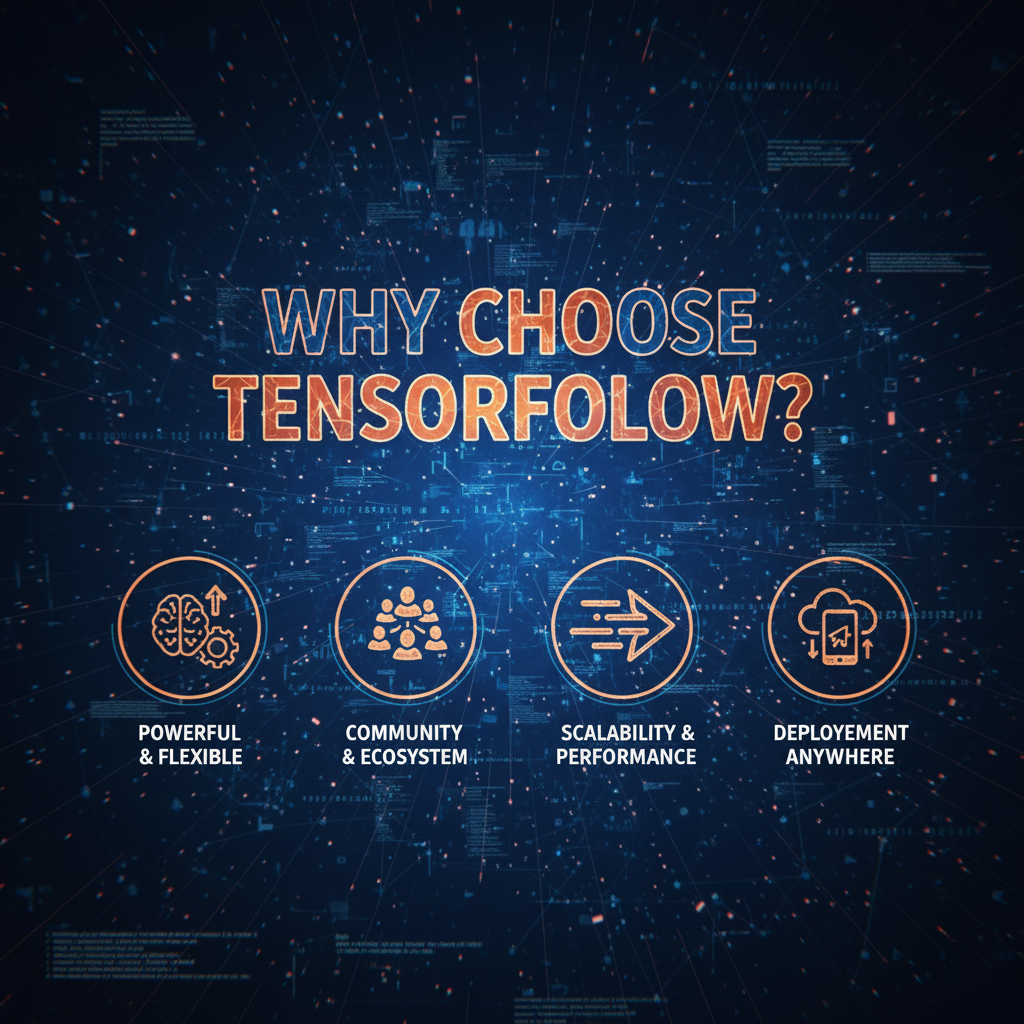
With so many ML frameworks available, what makes TensorFlow a top choice for so many professionals?
Scalability and Flexibility
TensorFlow is designed to handle projects of any size. Whether you are a student working on a small project on your laptop or a large company training a massive model on a cloud cluster, TensorFlow provides the tools to get the job done. Its architecture allows you to easily move from a small-scale prototype to a large-scale production system.
A Powerful Ecosystem
TensorFlow is not just a single library; it is a full ecosystem.
- Keras: This is a high-level API that is now part of TensorFlow. Keras makes building and training models incredibly easy and fast, even for beginners. It is simple to use and has a very user-friendly syntax.
- TensorBoard: This is a powerful tool for visualizing your model’s training process. You can see how your model is learning, analyze its performance, and debug any issues.
- TensorFlow Serving: This tool allows you to easily deploy your trained models into a production environment. It is built for high performance and can serve your model with low latency.
Strong Community Support
Since it’s backed by Google and used by countless researchers and companies, TensorFlow has a very active and supportive community.
- You can find extensive documentation, tutorials, and code examples online.
- If you run into a problem, chances are someone has already asked and answered a similar question on forums like Stack Overflow.
- Regular updates and new features are constantly being added, keeping the framework at the forefront of AI.
3. Getting Started with TensorFlow
Starting with TensorFlow is easier than you might think, especially with the help of Keras.
Installing TensorFlow
You can install TensorFlow using Python’s package manager, pip.
Bash
pip install tensorflow
This single command will install everything you need to get started on your computer.
A Simple Code Example: Your First Neural Network
Let’s look at a simple example to classify handwritten digits from the famous MNIST dataset.
Python
import tensorflow as tf
from tensorflow import keras

# 1. Load the dataset
(x_train, y_train), (x_test, y_test) = keras.datasets.mnist.load_data()
x_train, x_test = x_train / 255.0, x_test / 255.0

# 2. Build the model with Keras
model = keras.models.Sequential([
  keras.layers.Flatten(input_shape=(28, 28)),
  keras.layers.Dense(128, activation='relu'),
  keras.layers.Dropout(0.2),
  keras.layers.Dense(10, activation='softmax')
])

# 3. Compile the model
model.compile(optimizer='adam',
              loss='sparse_categorical_crossentropy',
              metrics=['accuracy'])

# 4. Train the model
model.fit(x_train, y_train, epochs=5)

# 5. Evaluate the model
model.evaluate(x_test,  y_test, verbose=2)
This short and clear code snippet shows how simple it is to build a powerful model using TensorFlow and Keras.
4. TensorFlow’s Ecosystem and Real-World Applications
TensorFlow’s true strength lies in its ability to adapt to different environments.
TensorFlow.js for the Web
This is a library that allows you to train and deploy ML models directly in a web browser.
- No Server Needed: Models can run completely client-side, making web applications faster and more responsive.
- Creative Applications: It is great for building interactive websites with real-time AI features, like image filtering or body pose estimation from a webcam feed.
TensorFlow Lite for Mobile and IoT
TensorFlow Lite is a lightweight version of TensorFlow designed for mobile devices, embedded systems, and IoT (Internet of Things).
- Optimized for Mobile: Models are optimized to be very small and fast, so they can run efficiently on devices with limited memory and processing power.
- Offline Capability: Models can run directly on the device, without an internet connection. This is perfect for applications that need to work offline.
Real-World Applications of TensorFlow
TensorFlow is used by companies all over the world for a variety of purposes.
- Google: It is used internally for many products, including search result ranking, Google Photos, and Google Assistant.
- Airbnb: Uses TensorFlow to power its search recommendation system.
- Uber: Employs TensorFlow to predict arrival times and optimize routes.
- Tencent: Utilizes TensorFlow to develop its AI-powered applications, including face recognition and smart chatbots.
5. Frequently Asked Questions (FAQs)
Is TensorFlow a difficult framework to learn for a beginner?
TensorFlow, especially when used with Keras, is quite beginner-friendly. The high-level Keras API simplifies many complex tasks, allowing you to build and train models with just a few lines of code.
What is the difference between TensorFlow and PyTorch?
Both are excellent frameworks. TensorFlow is known for its strong production and deployment capabilities, especially with tools like TensorFlow Serving. PyTorch is often preferred by researchers for its flexibility and ease of use in rapid prototyping.
Does TensorFlow support GPUs?
Yes, absolutely. TensorFlow is built to use GPUs and other accelerators to speed up computations, which is essential for training large neural networks. You just need to install the GPU version of TensorFlow.
What kind of programming language is used with TensorFlow?
The primary language for TensorFlow is Python. It also has official APIs for JavaScript (TensorFlow.js) and Swift, and community-supported APIs for other languages like Java and C++.
Is TensorFlow free to use?
Yes, TensorFlow is completely open-source and free to use for both personal and commercial projects.
Conclusion
In conclusion, TensorFlow is more than just a library; it is a powerful and comprehensive ecosystem that has helped shape the modern AI landscape. Its unique approach to using data flow graphs, combined with its vast set of tools like Keras, TensorFlow Lite, and TensorBoard, makes it a go-to choice for machine learning professionals everywhere.
For beginners, TensorFlow offers a smooth and intuitive learning curve through Keras. For large enterprises, it provides the scalability and robustness needed to deploy mission-critical AI applications. By choosing TensorFlow, you are not just picking a framework; you are joining a massive community and gaining access to a mature, well-supported, and flexible platform that will continue to evolve with the future of AI.