
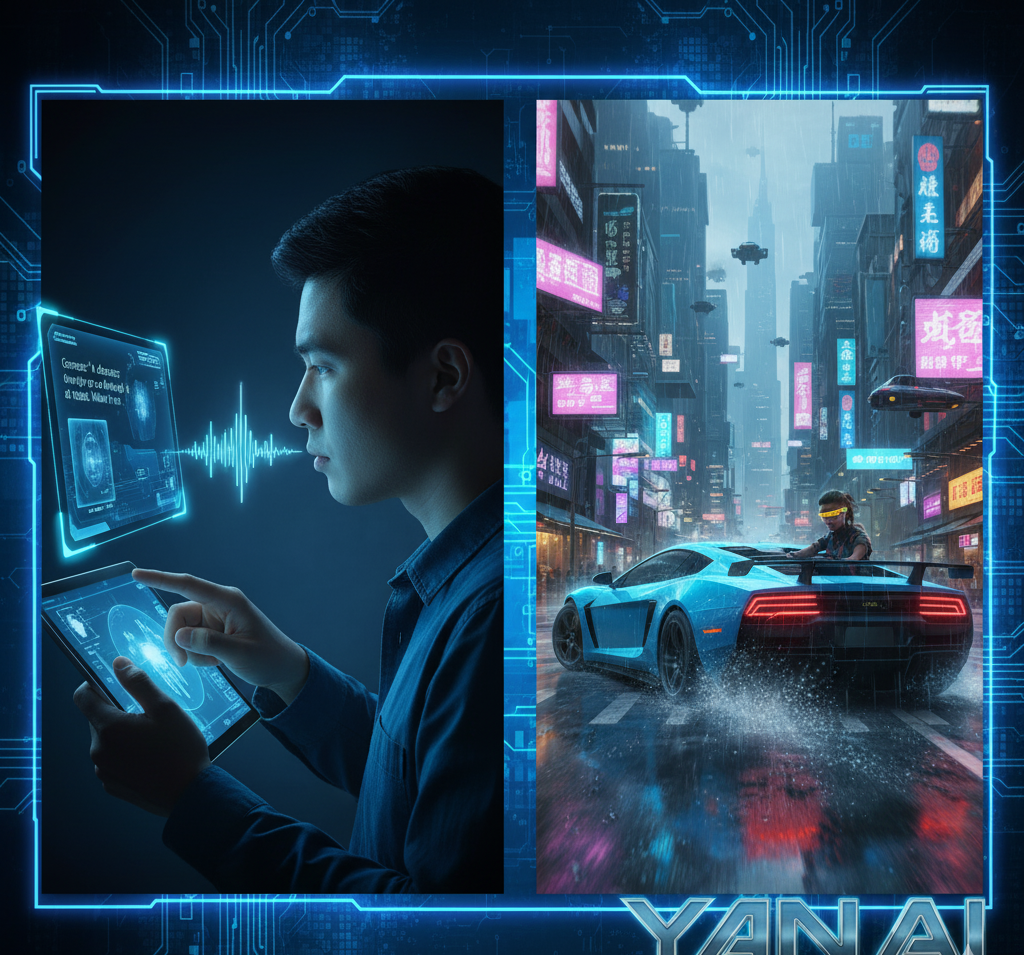
In the world of AI-generated content, we have seen some incredible advancements. Models like OpenAI’s Sora and ByteDance’s Waver can create stunning, photorealistic videos from a simple text prompt. But these videos are often static—they are a finished product that you can only watch. The true frontier of AI video is not just about generating a beautiful scene, but about creating an interactive, dynamic, and controllable world that users can influence in real-time.
This is where Yan AI steps in. Developed by the tech giant Tencent, Yan is a groundbreaking foundational framework that is redefining what AI video can do. It’s not a simple text-to-video tool; it is a complete, end-to-end system for interactive video generation. Yan can create playable scenes, respond to user commands, and edit content on the fly, pushing the boundaries of creativity and paving the way for the next generation of games, media, and entertainment.
This in-depth guide will take you on a deep dive into Yan AI. We will explore its innovative architecture, understand how it achieves real-time performance, compare it with its rivals, and discuss the profound impact it is having on the future of AI-driven content engines.
What is Yan AI? An Integrated Framework for Interactive Worlds
Yan AI is a cutting-edge framework that combines three powerful capabilities into a single, cohesive system: simulation, generation, and editing. Its primary purpose is to create AI-generated content that is not just visually stunning but also interactive and dynamic. It takes a user’s input—a text prompt or an action—and instantly generates a responsive video world.
The framework is a result of extensive research from Tencent AI Lab and is built on a massive dataset of over 400 million frames of interactive video data from modern 3D game environments. This is a crucial distinction. While other models are trained on passive video clips, Yan learns from interactive data, which teaches it how to respond to user commands and simulate realistic physics.
The Three Core Modules of Yan AI
The magic of Yan AI is powered by its three interconnected modules:
- Yan-Sim (AAA-level Simulation): This module is the engine for real-time physics and visual realism. It uses a sophisticated compressed model (3D-VAE) to achieve real-time 1080p/60FPS rendering. This is “AAA-level” because it’s the same quality you would find in a top-tier video game. It simulates physics, from a character’s jump to the way a car reacts to a bump in the road.
- Yan-Gen (Multi-Modal Generation): This is the creative brain of the system. It can generate entire worlds and scenes from a simple text or image prompt. Its key innovation is the ability to infuse “game-specific knowledge” into its generations. This means it can create a scene and also understand the rules of that scene, making it truly interactive. For example, if you prompt it to generate a scene of a character in a car, it knows the car should move on the road and not fly through the air.
- Yan-Edit (Multi-Granularity Editing): This module allows you to edit the AI-generated video in real-time. By using a hybrid model that separates the simulation mechanics from the visual rendering, you can change the style of the scene with a text prompt (e.g., “Change to a cyberpunk style”) while the underlying physics and mechanics remain the same. This gives you unparalleled control over the content.
The Technology Under the Hood: A Deep Dive into Yan AI’s Architecture
The incredible performance of Yan AI is the result of a groundbreaking architectural design that solves the classic challenges of real-time AI generation.
1. Ultra-Compressed VAE and Shift-Window Denoising
Traditional models struggle with the huge amount of data in a high-resolution video. Yan solves this with a highly compressed encoder (3D-VAE). It compresses the video data into a tiny digital representation (a “latent space”) while maintaining visual fidelity.
To achieve real-time performance, it uses a unique KV-cache-based shift-window denoising process. This technique allows the model to process frames in parallel using a “sliding window” method, which dramatically reduces the computational load and allows it to generate frames with a latency of just 0.07 seconds per frame.
2. Hierarchical Autoregressive Captioning
To solve the problem of “semantic drift” (where the AI forgets the initial prompt over a long video), Yan-Gen uses a hierarchical autoregressive captioning method. This is like a two-level memory system:
- Global Context: It keeps a “global” understanding of the entire world (e.g., “a snowy mountain landscape”).
- Local Context: It has a “local” understanding of the current frame and the user’s immediate action (e.g., “turn left and jump”).
This dual-level approach ensures that the video remains consistent with the initial prompt while still being dynamic and responsive to user input.
Yan AI vs. The Competition: A Head-to-Head Comparison
The AI video generation landscape is a battleground of giants. Here’s how Yan AI measures up against its key competitors like Google’s Veo and OpenAI’s Sora.
| Feature | Yan AI | Sora by OpenAI | Google Veo |
| Developer | Tencent | OpenAI | |
| Core Function | Interactive Video Generation. | Static, cinematic video generation. | Static, cinematic video generation. |
| Key Advantage | Real-time interactivity at 1080p/60FPS; unified framework. | Unmatched realism and complex scene understanding. | High-quality, long-duration video clips with great coherence. |
| Input/Output | Input command -> real-time generation -> dynamic editing. | Input prompt -> static video clip. | Input prompt -> static video clip. |
| Use Case | Video games, dynamic content, rapid prototyping. | Filmmaking, advertising, visual storytelling. | Filmmaking, advertising, visual storytelling. |
| Technology | Hybrid Diffusion-Transformer, 3D-VAE. | Diffusion-Transformer (DiT). | Proprietary technology. |
Export to Sheets
While Sora and Veo excel at creating beautiful, static video clips, Yan AI’s unique strength lies in its ability to create a dynamic and playable world. It is not trying to be a filmmaker’s tool; it is aiming to be a video game engine, which is a significant and important distinction.
Real-World Applications and Impact
The capabilities of Yan AI open up a world of possibilities for developers and creators.
- Game Development: Yan can be used to rapidly prototype game levels and scenarios. Designers can simply type a prompt like “a character sprinting through a futuristic city at sunset,” and the AI would instantly generate a playable environment.
- Dynamic Content Creation: For platforms like social media, Yan could be used to create interactive content where users can influence the video in real-time.
- Virtual Reality (VR) and Augmented Reality (AR): The model can be used to generate rich, immersive, and responsive VR and AR worlds without the need for a team of 3D artists.
- Educational Simulators: Yan can create educational simulators for training purposes, such as driving simulations or medical scenarios, all in a dynamic and interactive environment.
Yan is a testament to how intelligent design can solve complex problems and bring the benefits of AI to everyone in a secure and efficient way.
Conclusion: Yan AI is a New Frontier for Interactive Media
Yan AI is a monumental achievement by Tencent. It is a powerful, integrated framework that has effectively solved the long-standing problem of creating high-quality, interactive AI video. Its innovative architecture and three core modules set a new standard for the industry.
For developers and creators, Yan AI provides a robust, open-source tool for building the next generation of real-time, dynamic applications. For users, it means having access to new forms of entertainment and interactive content that were previously impossible.
Yan is a clear signal that the future of AI is not just in generating video clips, but in creating entire interactive worlds that we can play and edit in real time. It is a true game-changer that will shape the future of media and entertainment.