
For years, AI coding assistants have been a powerful tool for developers, helping with simple tasks like auto-completion and bug fixing. But the true dream of AI in software development has always been to create a model that can do more an AI that can understand the entire development lifecycle, from a simple idea to a production-ready system. An AI that doesn’t just write code, but also architects the solution.
That dream is now a reality. Kiro AI, a groundbreaking agentic IDE from AWS (Amazon Web Services), is completely redefining what’s possible with AI in software engineering. This is not just another code generator; it is a specialized AI that introduces a revolutionary “spec-driven development” methodology. It takes your high-level ideas, turns them into a structured plan, and then writes the code, ensuring everything is documented, tested, and ready for deployment.
This in-depth guide will take you on a deep dive into Kiro AI. We will explore its innovative architecture, understand how it achieves its superior planning capabilities, compare its performance with other leading models, and discuss the profound impact it is having on the future of software development.
What is Kiro AI? An Architect for Your Code
Kiro AI is a specialized, cloud-based AI-powered Integrated Development Environment (IDE). Its primary purpose is to help developers deliver production-grade applications with unprecedented clarity and speed. Developed by AWS, Kiro is a full-stack engineering assistant that focuses on the entire development lifecycle, from concept to code.
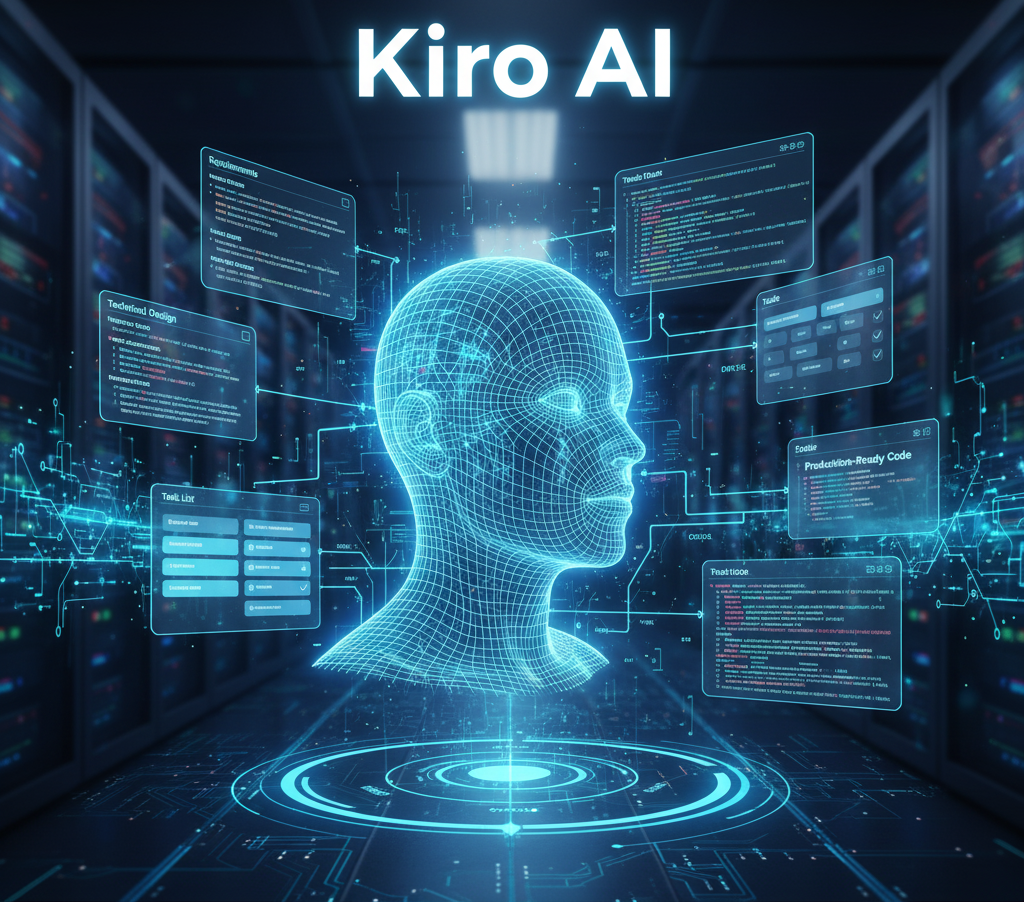
Kiro’s core innovation is its spec-driven development methodology. Instead of you giving the AI a series of fragmented prompts, Kiro encourages you to start with a clear, high-level goal. For example, “Add a user review system to the product page.” Kiro then translates this single prompt into a complete, structured plan, including:
- Requirements: It generates user stories and acceptance criteria.
- Technical Design: It creates data flow diagrams, database schemas, and API contracts.
- Task List: It breaks down the entire project into a list of tasks with dependencies and test cases.
This structured approach is what makes Kiro an “architect” for your code, not just a simple assistant.
Why Kiro AI is a Major Breakthrough
Kiro AI solves several key limitations of previous coding models:
- Structured Planning: Most AI coding tools follow a “vibe coding” approach, where you simply prompt and get code. Kiro, however, forces you to think through the problem first, ensuring that your code is well-structured and documented.
- Persistent Context: Traditional tools often “forget” the context of a project over a long chat session. Kiro uses specs and steering files to maintain a persistent project memory, which allows it to understand the full context of a large codebase.
- Full Lifecycle Control: Kiro doesn’t stop at code generation. It also automates tasks like creating unit tests, writing documentation, and running security scans, all from within the IDE.
- Agentic Capabilities: It is a true AI agent that can perform multi-step, autonomous tasks. It can read and modify multiple files, run shell commands, and provide real-time updates on its progress.
The Technology Under the Hood: A Deep Dive into Kiro AI’s Architecture
The incredible performance of Kiro AI is the result of a sophisticated architectural design and a revolutionary training approach. It’s a testament to how specialized AI can solve specific, real-world problems.
[Image placeholder for a diagram showing the Kiro AI development lifecycle: from Prompt to Specs, Specs to Tasks, and Tasks to Production-Ready Code.]
1. The Spec-Driven Workflow: From Prompt to Production
Kiro’s core innovation is its end-to-end workflow, which a developer can easily follow:
- Prompt to Requirements: You give Kiro a high-level prompt, and it generates a detailed requirements document with user stories and acceptance criteria. This ensures that the AI is solving the right problem from the start.
- Requirements to Design: Kiro then analyzes your existing codebase and generates a technical design document. It creates data flow diagrams, API contracts, and database schemas, which eliminates the lengthy back-and-forth between planners and developers.
- Design to Tasks: Kiro breaks down the design into a list of atomic tasks, each with its own dependencies, test cases, and code review checkpoints. This gives you a clear roadmap for the project.
- Tasks to Code: Kiro’s agents then execute the tasks one by one, generating and implementing the code. You can review and approve each change, maintaining full control over the process.
This structured workflow is what allows Kiro AI to transform an idea into a production-ready system with unprecedented speed and clarity.
2. Hooks: The Invisible Developer Automation
Kiro’s Hooks are a key feature for automating tedious, repetitive tasks. A hook is an AI agent that is triggered by a specific event. For example:
- On File Save: A hook can automatically generate unit tests for a function when you save the file.
- On Code Commit: A hook can automatically run a security scan on your code before you commit it to the repository.
- On New Feature: A hook can automatically generate documentation for a new feature once the code is finalized.
These hooks run in the background, freeing you from a lot of mental overhead and allowing you to focus on the bigger picture.
Kiro AI vs. The Competition: A Head-to-Head Comparison
The AI coding assistant landscape is a battleground of giants. Here’s how Kiro AI measures up against its key competitors like Cursor and other AI assistants. We will focus on the unique strengths that set them apart.
| Feature | Kiro AI | Cursor AI | Traditional AI Assistants |
| Developer | AWS (Amazon) | Anysphere | Various (e.g., Code Llama) |
| Core Function | Spec-Driven Development | AI-Native IDE (Copilot++) | Code Generation |
| Key Advantage | Planning-first approach, full lifecycle control. | Flexible, fast, conversational assistance. | Good for auto-completion and quick fixes. |
| Context | Persistent (uses specs and steering files) | Contextual to a single chat session. | Limited context. |
| User Control | Supervised Mode (requires approval for changes). | Collaborative (user-driven). | User-driven. |
| Open-Source | Yes (Apache 2.0 compatible) | No | Yes (Code Llama) |
Export to Sheets
Kiro AI’s unique strength lies in its specialization. While Cursor is an excellent pair-programming partner that fits into existing workflows, Kiro is an engineering co-pilot that enforces discipline and structure. It is for developers who want to move beyond a “prompt-to-code” mindset and build production-grade systems. For more on other AI tools, you can read our guide on [The Ultimate Guide to Qwen3-Coder] to see how it compares to Kiro’s focus on full lifecycle development.
Real-World Applications for Software Teams
The capabilities of Kiro AI open up a world of possibilities for developers and software teams. Here are some of the ways it can be used to revolutionize the software development lifecycle:
- Enterprise-Grade Consistency: For large teams, Kiro can ensure that every developer follows the same standards and best practices, from documentation to code structure.
- Onboarding New Developers: A new developer can simply read Kiro’s AI-generated specs to understand an entire codebase in a matter of minutes, drastically shortening the onboarding process.
- Proactive Refactoring and Testing: Kiro’s agents can continuously scan a codebase for potential improvements and bugs, and it can automatically generate and run unit tests.
- Institutional Memory: Kiro’s specs capture the design decisions and rationale behind a project, so even if a developer leaves, the project’s institutional memory remains intact.
To understand more about a different kind of calculator, you can check out our article on the [The Ultimate Guide to the Paycheck Calculator].
Conclusion: Kiro AI is the Future of Computer Interaction
Kiro AI by AWS is a monumental achievement in the field of AI. It is a powerful, open-source AI agent that is setting a new standard for AI-powered software development. Its innovative spec-driven development methodology and persistent context make it a formidable tool for professional developers.
For developers and software teams, Kiro is a game-changer. It is a tool that not only enhances the speed of their work but also provides a level of autonomy and control that was previously impossible.
Kiro AI is a clear signal that the future of AI is not just about writing code; it is about understanding, reasoning, and acting on our digital worlds. It is a tool that will empower us to automate our tasks, increase our productivity, and bring our ideas to life with a new level of confidence and efficiency. To learn more about this model, you can read the official blog post on the Kiro.dev website.