
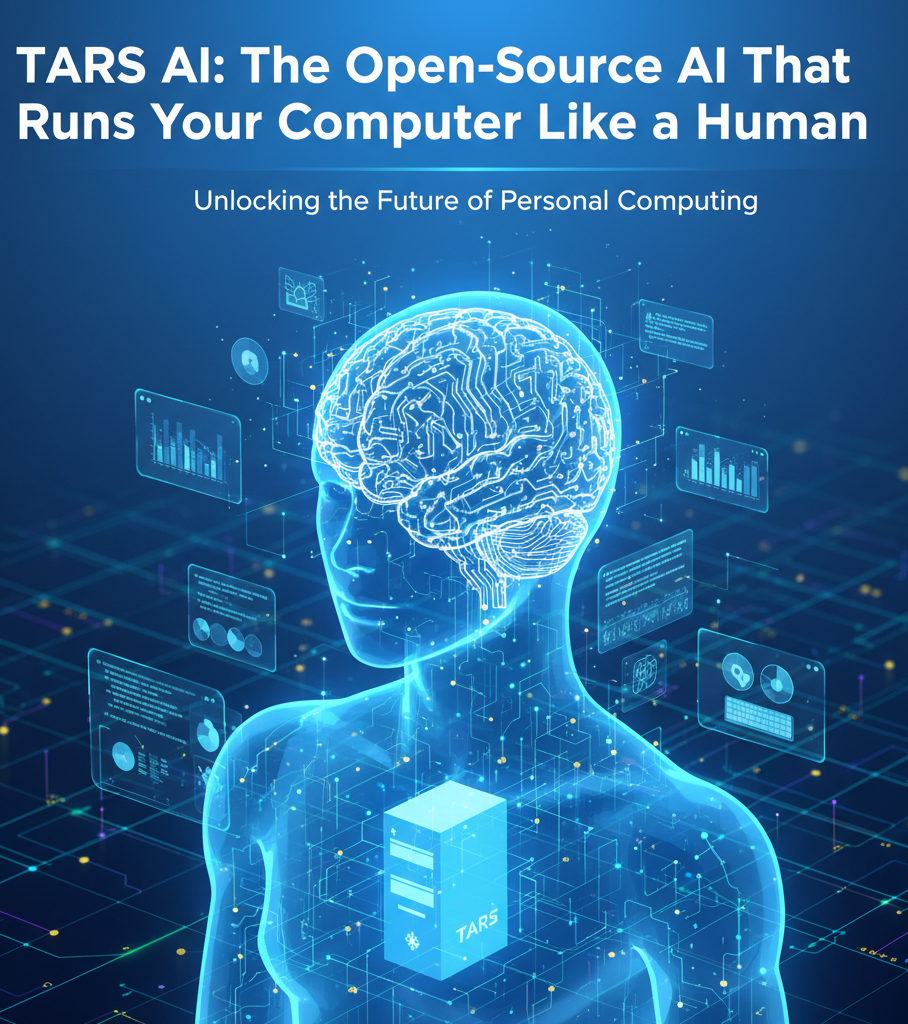
For decades, the dream of an AI that can use a computer just like a human has been a staple of science fiction. An AI that can see a screen, understand a user interface, and perform tasks like booking a flight or managing files, all without a single line of code. While many AI tools can help with specific tasks, a true “AI operating system” that can control a computer’s interface remained an elusive goal.
But that dream is now a reality. TARS, an innovative open-source AI operating system from the tech giant ByteDance, is completely redefining what’s possible with AI. TARS, which stands for Task Automation and Reasoning System, is a groundbreaking AI agent that can perceive, reason, and act on a computer’s screen, making it a powerful tool for automating complex workflows, managing applications, and even interacting with websites.
This in-depth guide will take you on a deep dive into TARS AI. We will explore its innovative architecture, understand how it achieves its superior “human-like” control, compare its performance with other leading models, and discuss the profound impact it is having on productivity, automation, and the future of human-computer interaction.
What is TARS AI? An All-in-One AI Operating System
TARS is a sophisticated multimodal AI agent designed to automate a wide range of computer tasks. Developed by ByteDance, the same company behind TikTok, TARS is not a single tool but a unified framework with a dual-component architecture:
- Agent TARS: This is the core AI engine. It’s a multimodal agent that handles the complex AI workflows, including understanding a user’s natural language command, visually perceiving a screen, and making a plan to execute the task. It’s the “brain” of the system.
- UI-TARS: This is the desktop application and graphical interface. It provides a user-friendly visual interface for task automation, making the power of Agent TARS accessible to everyone, regardless of their technical expertise.
The primary purpose of TARS is to simplify computer tasks, making a wide range of automation, from web scraping to managing files, accessible to all. It’s a tool that can interact with desktop applications, browsers, and terminals, all within a single, integrated platform.
Why TARS AI is a Major Breakthrough
TARS AI solves several key limitations of previous automation tools:
- Human-like Perception: Unlike traditional scripting tools that rely on pre-defined commands, TARS uses a vision-language model (VLM) to literally “see” and understand what’s on a screen. It can identify a button, a text box, or a menu item with a high degree of accuracy.
- Complex Reasoning: TARS is not just a simple executor; it’s a reasoner. It can break down a complex task (e.g., “Find the cheapest flight from New York to London and book it”) into multiple steps, and it can learn from its mistakes to improve its performance over time.
- Cross-Platform Compatibility: TARS is designed to work seamlessly across different platforms, including Windows, macOS, and Linux. This cross-platform support makes it a versatile tool for a diverse user base.
- Open-Source: ByteDance has released TARS as an open-source project under the Apache 2.0 license. This makes the technology accessible to developers and researchers worldwide, who can contribute to and build upon its foundational framework.
The Technology Under the Hood: A Deep Dive into TARS AI’s Architecture
The incredible performance of TARS is the result of a sophisticated architectural design and a revolutionary training approach. It’s a testament to how specialized AI can solve specific, real-world problems.
[Image placeholder for a diagram showing the TARS AI architecture with two main components: Agent TARS (the brain) and UI-TARS (the interface), and arrows showing data flow from a user prompt to a completed task on a computer screen.]
1. The Vision-Language Model (VLM) Core
At its heart, TARS uses a powerful vision-language model (VLM). This model is trained on a massive, proprietary dataset of GUI screenshots, action traces, and user tutorials. The AI learned to:
- Perceive: It can “see” a screenshot of a computer screen and understand the layout and function of all the elements on it.
- Reason: It can read a natural language prompt from a user and use its reasoning capabilities to make a plan to execute the task.
- Act: It can then translate its plan into a series of actions, such as a mouse click, a text input, or a keyboard shortcut.
This unified approach allows TARS to perform complex tasks that would be impossible for a traditional, rule-based automation tool.
2. Reinforcement Learning with Reflection
TARS was not just trained on data; it was trained to learn from its mistakes. The model uses a technique called reinforcement learning with reflection, which is a key innovation.
- The AI performs a task and then reflects on its actions.
- It evaluates its performance, identifies any errors, and uses that feedback to improve its strategy for the next time.
This iterative process makes TARS a much better problem-solver than its predecessors and allows it to adapt to new and unfamiliar user interfaces.
TARS AI vs. The Competition: A Head-to-Head Comparison
The AI agent landscape is a battleground of giants. Here’s how TARS AI measures up against its key competitors like GPT-4o and other AI automation tools. We will focus on the unique strengths that set them apart.
| Feature | TARS AI | GPT-4o | Traditional Automation Tools |
| Developer | ByteDance | OpenAI | Various (e.g., Selenium) |
| Core Function | GUI & CLI Automation | Versatile LLM (can do automation) | Script-based automation |
| Key Advantage | Open-source, human-like GUI interaction. | Unmatched reasoning and versatility. | Precise, but limited to pre-defined rules. |
| Learning | Learns from mistakes via reflection. | Learns from vast text and image data. | Requires manual updates to scripts. |
| Accessibility | Open-source, free to use. | API-based, with usage fees. | Requires coding knowledge. |
Export to Sheets
TARS AI’s unique strength lies in its specialization. While GPT-4o is an excellent general-purpose model, TARS’s training on a massive dataset of GUI screenshots gives it a specific edge in automating tasks on a computer’s interface. For a developer or a business, this is a significant advantage. It is a specialized tool for a specialized job. For more on other AI tools, you can read our guide on [The Ultimate Guide to Exists AI] to see how AI is revolutionizing other industries.
Real-World Applications for Creators and Businesses
The capabilities of TARS AI open up a world of possibilities for developers and software teams. Here are some of the ways it can be used to revolutionize the creative process:
- Web Scraping and Data Entry: A business can use TARS to automate tedious tasks like scraping data from websites or filling out online forms. The AI can see the form fields and know where to put the data, saving hours of manual work.
- Software Testing and Debugging: A developer can use TARS to automate the process of testing a software application. The AI can interact with the user interface, click buttons, and input data, all while looking for bugs.
- Customer Service and Support: A business can use TARS to create an AI assistant that can navigate a website to find information and answer customer queries, all in real-time.
- Everyday Productivity: A regular user can use TARS to automate daily tasks, such as organizing files, managing emails, or even booking a flight, all with a simple natural language prompt.
To understand more about a different kind of calculator, you can check out our article on the [The Ultimate Guide to the Loan Calculator].
Conclusion: TARS AI is the Future of Computer Interaction
TARS by ByteDance is a monumental achievement in the field of AI. It is a powerful, open-source AI agent that is setting a new standard for AI-powered computer interaction. Its innovative VLM architecture and learning capabilities make it a formidable tool for developers and businesses.
For creators, developers, and aspiring designers, TARS is a game-changer. It is a tool that not only enhances the speed of their work but also provides a level of accessibility and control that was previously impossible.
TARS is a clear signal that the future of AI is not just about generating content; it is about understanding, reasoning, and acting on our digital worlds. It is a tool that will empower us to automate our tasks, increase our productivity, and bring our ideas to life with a new level of confidence and efficiency. To learn more about this model, you can read the official announcement on the Geeky Gadgets blog.